Your Bathroom Fan Is Probably Causing Your Mold — Here Is How to Check
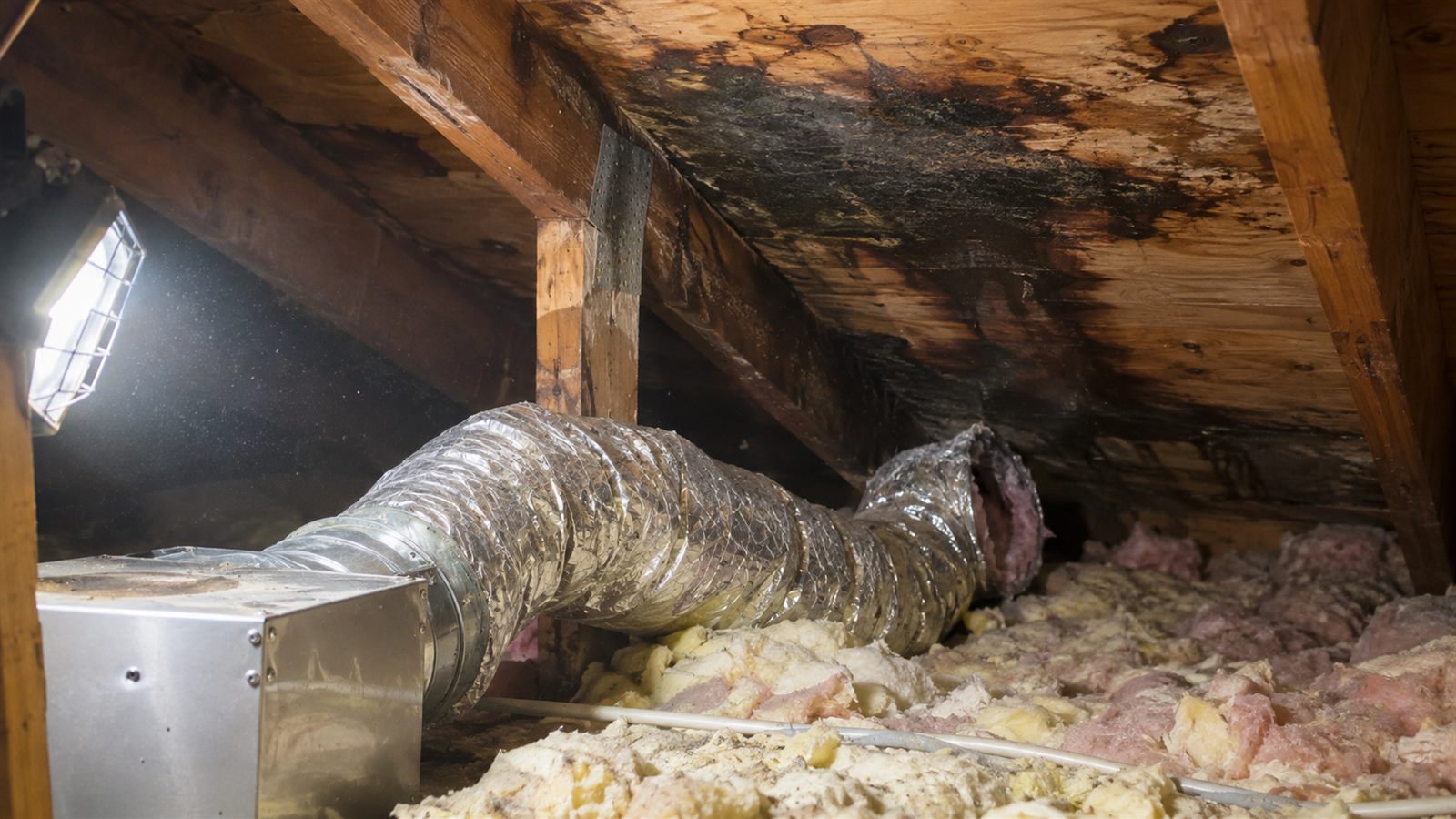
Across San Diego County, the single most common fixable cause of residential mold is a bathroom fan that does not exhaust outside the building. That is bathroom exhaust fan mold, and it appears in two places at once: the bathroom mold you can see and the attic mold you cannot.
Quick answer
How do I know if my bathroom fan is causing mold? Go into the attic and physically follow the duct from the fan housing. It should run in insulated duct to a roof or gable terminal with a backdraft damper. If it ends loose in the insulation, dead-ends at a soffit, or there is no duct at all, every shower is depositing moisture onto your roof sheathing. From inside, hold a sheet of toilet paper against the grille with the fan running — if it does not hold, the fan is not moving meaningful air.
Why this matters more in San Diego than almost anywhere
A shower releases roughly two to three pints of water into the air. In a dry climate with a drying cycle, some of that leaves through the window and the rest evaporates away during the day.
On the San Diego coast from May through September, outdoor morning relative humidity commonly sits at 80 to 90 percent. Opening the window does not dry the room; it brings in air that is already nearly saturated. And a large share of coastal homes have no air conditioning to remove moisture either. So mechanical exhaust, properly terminated, is the only path out for that water.
Which is why a dead or misdirected fan in San Diego produces consequences that the same fan would not produce in Phoenix.
The fifteen-minute check
- The tissue test. Turn the fan on and hold a single sheet of toilet paper against the grille. It should hold firmly. If it falls or barely clings, the fan is not moving useful air — usually a seized bearing, a dust-loaded housing, a disconnected duct or a crushed flex run.
- Follow the duct in the attic. Find the fan housing from above and physically trace the duct. You are looking for insulated flexible or rigid duct running as short and straight as practical to a roof jack or gable terminal.
- Look for the failure modes. A duct lying loose in the insulation with the end open. A duct that terminates at a soffit, so the moist air is immediately drawn back in through the soffit intake. A duct that is disconnected at the fan or at the terminal. A long sagging run full of condensate. No duct at all, with the fan simply discharging into the attic.
- Look at the sheathing directly above and around the bathroom. A dense patch of dark growth on the roof deck above a bathroom is the signature.
- Check the terminal from outside. A proper roof or wall terminal has a backdraft damper. Check it is not painted shut, blocked by a bird nest, or corroded open — near the coast, corrosion gets them within a decade.
Sizing, and why many San Diego fans are too small
Fifty CFM is the common minimum for a bathroom under about 100 square feet. Above that, roughly 1 CFM per square foot, with more for a separate enclosed shower, a jetted tub or a steam shower.
Two local realities. First, a lot of San Diego bathrooms still run a 1970s or 1980s fan originally rated around 30 CFM, which by now has lost a substantial share of that capacity to dust and bearing wear. Second, rated CFM is measured at a specific static pressure; a long, kinked or undersized duct can halve real delivered airflow even on a new fan. Short and straight matters as much as the number on the box.
Run it after the shower, not during
This is the cheapest improvement available to you and it is almost universally done wrong. People run the fan while showering and switch it off on the way out — at exactly the moment the room is most saturated and the surfaces are wet.
Twenty minutes after the shower is when the fan does most of its useful work. A timer switch costs about $25 and makes it automatic. In coastal San Diego this single change prevents more bathroom mold than any other intervention.
What a correct installation looks like
- Fan sized to the room, with a sone rating low enough that people will actually use it.
- Insulated duct — uninsulated duct in a cold attic condenses internally and drips back into the fan housing.
- As short and straight as the geometry allows; every bend costs airflow.
- Terminating through the roof or a gable wall, never into the attic, never into a soffit, never into a wall cavity.
- A proper terminal with a working backdraft damper.
- A timer switch or a humidity-sensing switch.
Cost to put right: typically $350 to $900 per fan including the re-duct. Against a $1,800 to $4,800 attic remediation, it is the best value item in this entire website.
Sizing, run time and the two things people get wrong
Fan capacity is rated in cubic feet per minute. The working rule for a bathroom under about 100 square feet is one CFM per square foot, with a minimum of 50; above that, add 50 CFM for a separate shower enclosure and 50 for a jetted tub. A 50 CFM fan in a 90-square-foot coastal bathroom is undersized by a third, which is extremely common in 1960s and 1970s San Diego tract housing where the original fan was never upgraded.
Run time matters as much as capacity. A shower puts two to three pints of water into the air; the fan has to keep running after the shower stops to get it out. Twenty minutes is the working figure, and a $25 timer switch is a more reliable fix than asking a household to remember. Running the fan during the shower and switching it off on the way out removes maybe half the moisture.
The two things people get wrong: assuming the fan works because it makes noise, and testing it with a hand instead of a tissue. Hold a single sheet of toilet tissue against the grille. If it does not hold itself there, the fan is moving almost no air — usually because the duct is crushed, disconnected, or blocked by a backdraft damper that has seized.
Where the duct goes, and why that is the real problem in this county
A great many San Diego bathroom fans terminate in the attic or in a soffit rather than through the roof or a wall cap. That is not a minor code detail. It means every shower pumps warm, saturated air into the attic, where it meets a roof deck that cools overnight, and the moisture condenses on the underside of the sheathing.
This is the origin of most of the attic mold we see in the county, and it has a distinctive signature: diffuse grey-black staining spread evenly across the deck rather than radiating from a point. A roof leak radiates from the penetration above it. Even spread means condensation, and condensation means a fan, a dryer or a blocked soffit vent.
How to check: go into the attic with a torch and find where the bathroom duct ends. If it ends in open attic space, in insulation, or at a soffit that also serves as an intake vent, that is the defect. The fix is a properly supported insulated duct running the shortest practical route to a roof or wall cap with a backdraft damper — and remediating the sheathing without fixing the duct guarantees a repeat.
Makeup air, and the coastal bathroom that cannot clear steam
A fan can only exhaust as much air as it can replace. A bathroom with a tight-fitting solid door, no undercut and weatherstripping on three sides starves the fan: it runs, it makes noise, and the room stays steamy. The standard remedy is a half-inch to three-quarter-inch gap under the door, or a transfer grille.
This bites hardest in two San Diego cases. In coastal houses with no air conditioning, the makeup air arriving under the door is itself at 80 to 90% relative humidity for much of the year, so the fan has to move considerably more of it to achieve the same drying — which is an argument for longer run times rather than for a bigger fan. And in newer tight-envelope construction, there may be very little infiltration anywhere in the building, so the fan depressurises the room against a sealed shell and moves almost nothing.
The order to work through: tissue test the fan, trace the duct in the attic, check the door undercut, then size the fan. Replacing the fan first — which is what most people do — fixes the problem only when the fan was genuinely the weakest link.
Frequently asked questions
My fan vents into the soffit. Is that acceptable?
No, and it is one of the worst arrangements. The soffit is also where your attic draws its intake air, so moist bathroom air discharged at the soffit is pulled straight back into the attic by the ventilation path you are relying on. It achieves close to nothing and it loads the roof sheathing with moisture. It should terminate through the roof or a gable wall.
Can I use a humidity-sensing switch instead of a timer?
Yes, and in a coastal San Diego bathroom it can work better, because it runs until the room actually reaches the setpoint rather than for a fixed period. The caveat is that in a house where ambient humidity is already high, a humidity switch can run very long cycles or never satisfy. Many models let you set an absolute setpoint plus a maximum run time, which is the combination you want.
The bathroom has a window. Do I still need a fan?
At the coast, yes. A window is only useful ventilation when the air outside is drier than the air inside, and from May through September on the San Diego coast that is frequently not true in the morning. Inland, in El Cajon or Escondido, a window is genuinely useful most of the year. This is one of the clearest examples of why generic advice fails in this county.
How do I know if my bathroom fan is actually working?
Hold one sheet of toilet tissue against the grille with the fan running. If it does not stay there on its own, the fan is moving almost no air — typically a crushed or disconnected duct, a seized backdraft damper, or no makeup air because the door seals too tightly.
Can a bathroom fan cause mold in my attic?
Yes, and in San Diego it is the most common cause of attic mold. A fan ducted into the attic or into a soffit pumps saturated air against a roof deck that cools overnight, and the moisture condenses on the sheathing. The signature is even grey-black staining across the deck rather than a stain radiating from one point.
Related reading
- bathroom mold removal in San Diego
- attic mold removal in San Diego
- indoor humidity control in coastal San Diego
- mold removal Pacific Beach
Need help with this in San Diego? We provide Bathroom Mold Removal in San Diego across all 34 service areas. Free phone consultation, 24/7 — (858) 400-3506.