Atmospheric River Season: Preparing a San Diego Home for the Storms That Matter
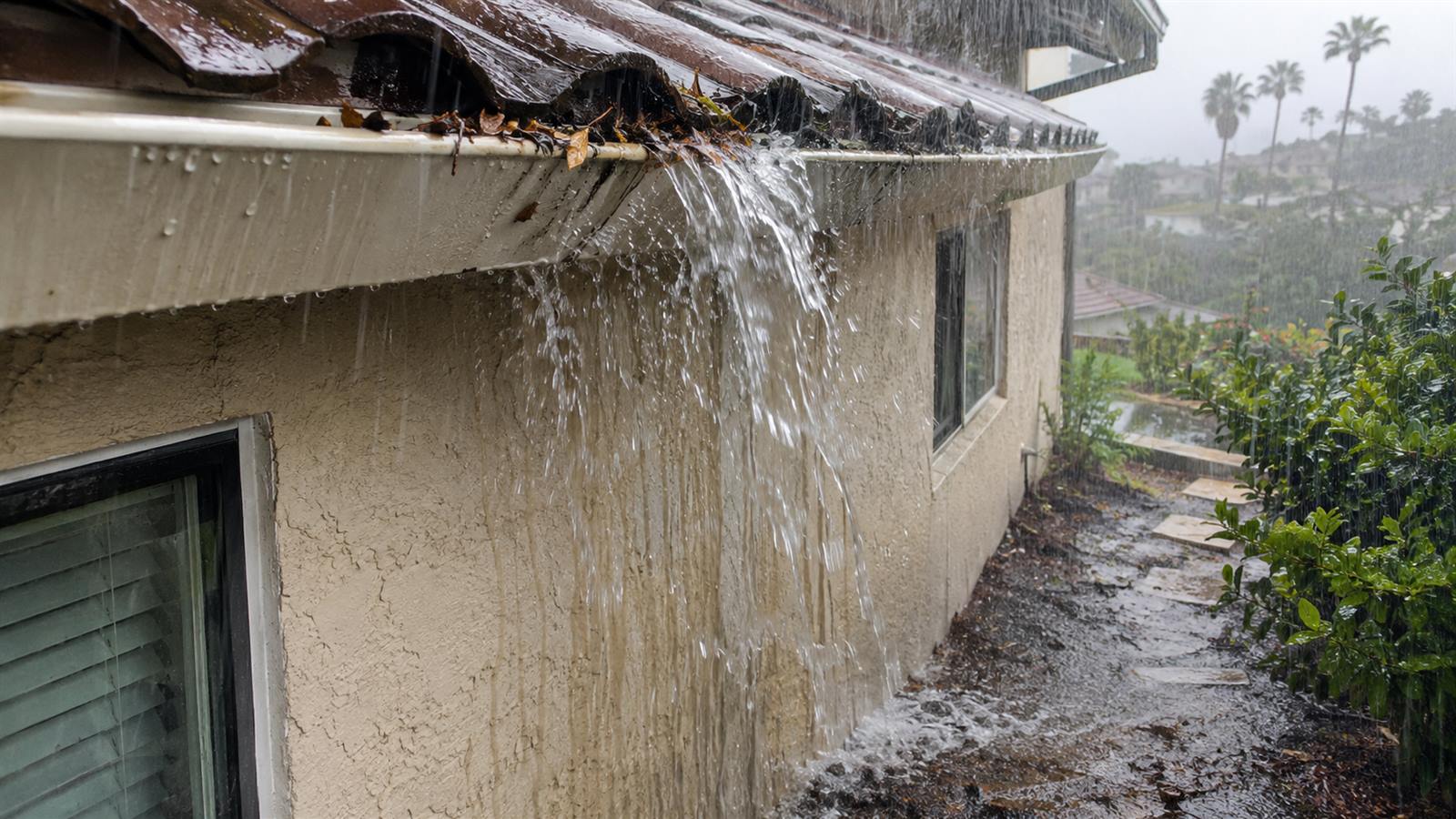
San Diego's ten inches of annual rain does not arrive gently across the year. It arrives in a handful of atmospheric river events, and almost every defect that has been dormant since last winter gets found on the same afternoon.
Quick answer
How do I prepare a San Diego home for winter storms? An atmospheric river over San Diego does its damage through drains and the ground rather than through the roof, so the preparation that matters is mostly at ground level. Before the first significant rain: clear gutters, roof valleys and area drains; check that downspouts discharge away from the foundation; verify grade slopes away from the house and that weep screed at the base of stucco walls is not buried; inspect roof-to-wall junctions for kick-out flashing; clear crawl space vents and check the vapor barrier; and test the sump if you have one. In a flood-exposed area, add sandbags and move stored items off the ground.
Why San Diego storms punish deferred maintenance
In a climate with regular rainfall, a marginal flashing detail leaks a little every month and gets noticed. In San Diego, nothing tests the building from roughly April to November. Then an atmospheric river delivers two or three inches in a day, driven sideways by wind, and every dormant defect fails at once.
That is why our winter call volume spikes so sharply, and why the autumn checklist below has a much better return here than the same list would in Seattle.
The roof and drainage checklist
- Clear gutters and downspouts. Essential everywhere, critical under canopy — Scripps Ranch, Leucadia, La Mesa Village, North Park, South Oceanside. Eucalyptus bark and leaf litter blocks gutters within a season.
- Clear roof valleys and crickets. A blocked valley backs water up under the roofing and into the sheathing. This is the leading roof-leak mechanism in canopy neighborhoods.
- Check downspout discharge. Water should be carried at least four to six feet from the foundation, ideally into a drain line. A downspout dumping at the stem wall saturates the soil against your foundation for the entire storm.
- Clear area drains and yard inlets. On hillside properties in Bay Park, La Mesa, San Marcos and Encinitas, a blocked area drain sends sheet flow toward the house or the downhill neighbour.
- Look at roof-to-wall junctions for a kick-out diverter. If it is missing on a 1990s or 2000s stucco home, this is the single most valuable thing to correct before winter.
The ground-level checklist
- Grade should slope away from the house — roughly six inches of fall over the first ten feet. Decades of landscaping, mulch top-ups and hardscape frequently reverse it.
- Weep screed must be visible with clearance at the base of stucco walls. If soil, mulch, concrete or a planter bed has buried it, drained water inside the wall has no exit and wicks upward into the framing instead.
- Foundation vents clear on raised-floor homes, with nothing stacked against them.
- Window wells and light wells clear and draining.
- Check the crawl space before the rain — vapor barrier intact, no standing water, no signs of previous entry. It is far easier to look in October than in February.
If you are in a flood-exposed area
Mission Valley, the San Diego and San Luis Rey river corridors, the Chollas Creek corridor, western Chula Vista, National City, low-lying Imperial Beach, Santee along the river, and the Escondido and San Marcos creek corridors.
- Get sandbags before the forecast, not during it. Many San Diego County cities and fire stations distribute them free ahead of storms.
- Move stored items off garage and ground-floor floors onto shelving.
- Know where your main water shutoff and electrical panel are, and keep a torch there.
- Photograph your property and contents now, while dry. It makes any later claim dramatically easier.
- Check whether you actually have flood coverage. A homeowners policy does not cover surface flooding, and NFIP policies typically have a 30-day waiting period — so October is the time to buy, not January.
During and after the storm
During: walk the house during the first heavy rain if you safely can. This is the single best time to find leaks, because a stucco wall that has dried for three weeks shows almost nothing. Look at window heads, ceiling-wall junctions, the top of exterior walls, and around any penetration. Note where water appears, even a damp patch that dries.
After: check the crawl space, the attic above any roof plane that takes direct weather, under sinks and behind appliances on exterior walls, and the base of walls in a slab home. Mold begins colonising within 24 to 48 hours, so finding water on day one rather than week three is the difference between drying a wall and replacing it.
Why ten inches a year is more dangerous than thirty would be
San Diego County averages roughly ten inches of rain annually, and a meaningful share of it arrives in a handful of storms. A building in a climate with steady rainfall gets tested weekly; small defects announce themselves early and get fixed. A building here can hold a flashing gap, a blocked weep screed and a failed penetration seal for eight dry months with no symptom whatsoever, and then every one of those defects fails on the same afternoon, under wind-driven rain, simultaneously.
That is why the week after an atmospheric river produces a spike in calls, and why the calls describe interior damage with no obvious source. It also explains the second spike, four to eight weeks later, from the households whose walls got wet, dried on the surface and were never opened. Surfaces dry in days; framing, sheathing and insulation do not.
The before-the-storm list, in the order that pays
Clear gutters, downspouts and the ground where they discharge. A downspout discharging against a stucco wall at a buried weep screed is the cheapest serious defect in the county to fix and one of the most damaging to leave.
Check that grade falls away from the building for the first six feet. Decades of added planters, patios and raised beds have reversed the grade on a great many San Diego properties.
Confirm foundation vents are clear if you have a raised floor. A crawl space that cannot ventilate after taking storm water stays wet for months.
Look at the roof-to-wall junctions for a kick-out flashing, and at window head details on west and south elevations. These are the two defects that take the most water in the least time.
Photograph the exterior while it is dry. Dated before-photographs are what turn a disputed claim into a paid one.
Test the water meter and know where the main shut-off is. Storm season is also when supply failures get discovered late.
The forty-eight hours after, and the four weeks after that
Walk the exterior while it is still wet and photograph slow-drying dark patches on stucco. They are invisible the next day and they mark the saturated areas.
Check the interior face of exterior walls below windows and the bottom twelve inches of walls under any roof-to-wall junction. Touch the baseboard; look for a tide-line, swelling or separation.
Get air moving on anything that got wet, inside 24 to 48 hours. That is the window in which wet cellulose has not yet been colonised, and it is the difference between drying a wall and rebuilding it.
Report to the carrier promptly, before demolition. California policies typically cover the sudden event and exclude long-term seepage; the wording of the first report and the dates on the photographs are what decide which category the loss lands in.
Then re-check at four weeks. A stain that reappears, a baseboard that stayed swollen, a smell that arrived and did not leave. That is the signal the assembly never dried, and it is far cheaper to act on at week four than at month six.
Frequently asked questions
When should I do this checklist?
October is ideal in San Diego — after the last of the dry heat and before the first meaningful rain, which typically arrives from late November onward but can come earlier. If you have missed that window, do it anyway: the biggest storms usually come in January and February, so there is almost always time left to matter.
Is it worth having a roof inspection every year?
Every two to three years is reasonable for most San Diego homes, annually under heavy canopy or within a few hundred yards of the surf, where debris and salt corrosion both accelerate failure. Tile roofs deserve particular attention because the tile outlasts the underlayment beneath it by decades — the roof can look perfect while the felt has failed, and the first symptom is attic sheathing mold.
What is the single highest-value item on this list?
For most San Diego homes, clearing gutters and roof valleys, because it is free and it prevents the most common storm-season roof leak. For 1990s and 2000s stucco homes specifically, checking for missing kick-out flashing at roof-to-wall junctions, because that one detail produces some of the largest concealed water losses we see.
My wall got wet in a storm and dried by itself. Is that fine?
The surface dried. Framing, sheathing and insulation behind it hold moisture far longer, and mold on wet cellulose starts within 24 to 48 hours. Check the same spot at four weeks: a stain that returns, a baseboard still swollen or a smell that arrived and stayed means the assembly never reached a dry standard.
What single thing should I fix before the next storm?
Where your downspouts discharge. Water landing against a stucco wall at a buried weep screed defeats the whole drainage design of the cladding, it is cheap to redirect, and it is behind a large share of post-storm interior damage in the county.
Related reading
- water damage restoration in San Diego
- emergency mold removal in San Diego
- stucco moisture intrusion in San Diego
- water damage in the first 24 hours
Need help with this in San Diego? We provide Water Damage Restoration in San Diego across all 34 service areas. Free phone consultation, 24/7 — (858) 400-3506.