Does a Dehumidifier Actually Stop Mold? It Depends Where You Live in San Diego
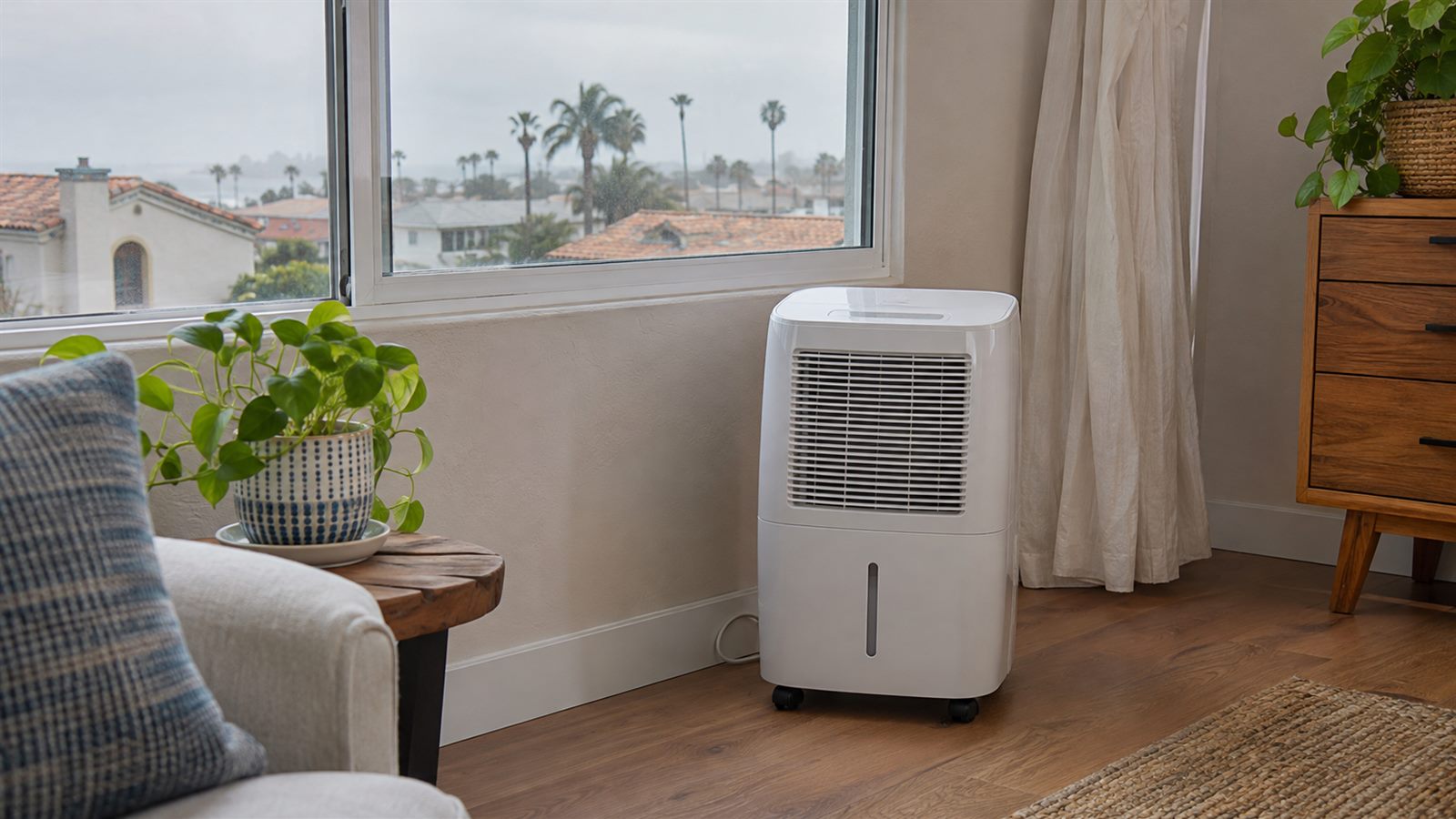
A dehumidifier is the right answer to one specific San Diego mold problem and completely beside the point for another. Which one you have depends mostly on how far you are from the water.
Quick answer
Does a dehumidifier stop mold? It will prevent mold caused by ambient humidity, which is a large share of coastal San Diego mold. It will not stop mold caused by a leak, a slab leak, groundwater or a failed shower pan, because those keep the material wet regardless of the air. The test is simple: if a hygrometer shows the whole house consistently above 60 percent relative humidity, dehumidification is your answer. If one area is wet and the rest of the house is normal, you have a leak.
The two different problems
Ambient humidity mold. The air in the house is humid enough that cool surfaces reach a surface relative humidity high enough for growth. Typical in coastal San Diego homes with no air conditioning from May through September. The mold appears in closets, on north-facing exterior walls, behind furniture, on leather and fabric, across multiple rooms, with no leak anywhere. A dehumidifier fixes this.
Liquid water mold. Something is wetting a material directly — a pipe, a roof, a shower pan, groundwater, a slab leak. The growth is localised and the material is wet to a meter even when the room air is normal. A dehumidifier does nothing useful here, because the water supply does not stop.
A $15 hygrometer logged over a week tells you which you have, and that is the cheapest diagnostic in this entire field.
Where a dehumidifier earns its money in San Diego
- Coastal homes without air conditioning — Mission Beach, Ocean Beach, Pacific Beach, Imperial Beach, Coronado, the Del Mar Beach Colony, lower La Jolla.
- Lagoon-corridor homes in Carlsbad, Encinitas and the Buena Vista corridor into Vista, where overnight humidity runs higher than the distance from the ocean suggests.
- Encapsulated crawl spaces. A sealed crawl space needs a dedicated unit, and this is one of the highest-value applications in a San Diego raised-floor home.
- Ground-floor units and below-grade spaces where capillary moisture through a slab keeps humidity elevated.
- Properties left vacant through the summer — a sealed unconditioned coastal house grows mold on interior surfaces with no leak at all, and a humidistat-controlled dehumidifier prevents it.
Where it is the wrong tool
- Inland in summer. El Cajon, Santee, Escondido, Poway, Ramona. The air is already dry; a dehumidifier runs and removes almost nothing. If you have mold there, look at plumbing or at your evaporative cooler.
- Any active leak. Running a dehumidifier next to a slab leak simply makes you feel productive while the material stays wet.
- Mold already growing inside a wall or under a floor. Room air does not reach it. Only opening, removing and drying the assembly does.
- As a substitute for bathroom exhaust. Fixing the fan is cheaper, removes the moisture at source, and also fixes the attic problem the fan is causing.
Sizing and buying
- Buy bigger than the box suggests. Capacity ratings are measured at test conditions that are warmer and more humid than a 68-degree coastal San Diego living room. A unit rated for a larger area will reach the setpoint and cycle rather than running flat out and never getting there.
- Look for a true humidistat, not just a timer or fan speeds, so it holds a setpoint.
- Continuous drain capability is close to essential. A unit that stops when its bucket fills is a unit that is off for most of the day. Plumb it to a sink, a floor drain or a condensate pump.
- Auto-restart after a power interruption, which matters for a unit running unattended in a crawl space or a vacant property.
- For a crawl space, buy a crawl-space-rated unit. A household dehumidifier in a sealed crawl space fails quickly — they are not built for the temperature range, the dust or the continuous duty.
Running it so it actually works
- Set it to hold 50 to 55 percent relative humidity. Lower settings waste energy and are not necessary; the target is staying below 60, not reaching 35.
- Place it centrally with internal doors open, or in the worst-affected area if the problem is localised to one part of the house.
- Keep windows and doors closed while it runs. A dehumidifier cannot win against open windows on a humid morning.
- Clean the filter monthly. A loaded filter kills capacity, and this is the most common reason a unit stops performing.
- Verify with a separate hygrometer rather than trusting the unit's own display, which is often several points optimistic.
- Combine it with air movement at cool surfaces: closet doors ajar, furniture off exterior walls, a fan on low.
What a dehumidifier can and cannot reach
A dehumidifier removes water vapour from the air that passes through it. That makes it effective against one cause of mold and almost useless against the others, and the distinction decides whether buying one solves your problem or just adds $200 and some noise.
It works where the moisture is in the room air: coastal humidity in a house with no air conditioning, a bedroom that sits at 70% every morning, an evaporative cooler loading the air in East County, a laundry with the dryer vented indoors, a basement-like lower level cut into a hillside.
It does not work where liquid water is entering an assembly. A slab leak pushes water into concrete and up through wall bases; a shower pan leaks into a floor cavity; a window head flashing lets a storm into a wall. The dehumidifier is drying room air while the assembly behind the plaster stays saturated, and it will keep doing that indefinitely. The stain comes back, the smell stays, and the owner concludes the machine is faulty.
The test is simple: if the surface relative humidity drops but the moisture meter reading in the wall does not, you have a liquid source, not a humidity problem.
Running one properly: setpoint, drainage, placement, temperature
Drain it to a fixture. The most common reason a dehumidifier underperforms is a full bucket. A unit that shuts off at 3 a.m. runs a third of the hours you think it does. A garden hose to a laundry standpipe or a sink is a ten-minute job and roughly doubles the effective capacity.
Set 50% while drying down, 55% to maintain. Chasing 40% in coastal air means fighting infiltration continuously for a result mold does not care about; the threshold that matters is sustained humidity below 60%.
Central, clear, door open. Eighteen inches of clearance, not in a closet or behind furniture. It can only dry air that reaches it, and in a two-storey house the upstairs hallway usually beats the downstairs living room.
Watch the temperature. Compressor units lose capacity below about 65°F, which matters in an unheated coastal garage, a crawl space in January, or a vacation property left unheated. Desiccant units keep working colder and cost more to run.
Give it weeks, not days. Pulling a building's materials down to equilibrium takes two to four weeks of continuous running. Judging it after a weekend tells you nothing.
The cheaper measures that often make the machine unnecessary
Every item here removes a moisture source rather than extracting water after the fact, which is both cheaper and more permanent.
Vent the tumble dryer outside. Four to six pints per load is the largest single indoor source in most households, and an indoor-vented dryer can defeat a 50-pint dehumidifier on laundry day.
Put bathroom extraction on a twenty-minute timer. About $25, and it removes the two to three pints a shower adds at the point of release.
Vent the range hood outside rather than recirculating.
Close up in the morning, open in the afternoon on the coast. Reverses the habit most people have and is worth several points of indoor humidity for free.
Pull furniture two inches off exterior walls and vent closets. Growth happens where still air meets a cold surface; restoring air movement removes the condition.
Fix crawl-space ventilation. In a pre-1940 raised-floor house, ground moisture rising through floor penetrations can be the largest source in the building, and no amount of indoor dehumidification addresses it.
Frequently asked questions
How much does it cost to run?
A portable unit running a duty cycle during the humid months typically costs a few dollars a week in electricity in a coastal San Diego home — considerably less than one service call, let alone one remediation. It also slightly warms the room it is in, which in a cool coastal house is often welcome. Running costs rise if the unit is undersized and never cycles off, which is another argument for buying bigger.
Will it help with the musty smell?
If the smell comes from ambient humidity and surface growth, yes, within days to a couple of weeks as surfaces dry and growth becomes inactive. If the smell comes from growth inside a wall, under a floor or in the crawl space, a dehumidifier in the living room will do very little, because it is not reaching the air in that assembly. A persistent musty smell that a dehumidifier does not touch is a strong indicator of hidden growth.
Do I need a whole-house dehumidifier?
Rarely in a San Diego single-family home. A portable unit or two covers most coastal houses at a fraction of the cost. A ducted whole-house unit makes sense in a larger tight home with existing ductwork, in a property where the owner will not manage a portable unit, or where several separate areas need control. For a crawl space, a dedicated crawl-space unit is a different and usually worthwhile purchase.
I have run a dehumidifier for weeks and the stain keeps returning. Why?
Almost certainly because the water is liquid rather than vapour. A dehumidifier dries room air; it cannot dry an assembly that is being fed by a slab leak, a shower pan or a flashing defect. Put a moisture meter on the wall: if the reading stays elevated while the room humidity drops, you are looking for a leak, not more capacity.
What humidity should I set it to?
50% while the building is drying down, then 55% as a maintenance setting. The threshold that matters for growth is sustained relative humidity below 60%, measured in the problem room rather than the hallway. Chasing 40% in coastal air costs electricity for no additional benefit.
Related reading
- indoor air quality testing in San Diego
- crawl space mold removal in San Diego
- indoor humidity control in coastal San Diego
- the marine layer and mold in San Diego
Need help with this in San Diego? We provide Indoor Air Quality Testing and Improvement in San Diego across all 34 service areas. Free phone consultation, 24/7 — (858) 400-3506.