How Long Does Mold Remediation Take?
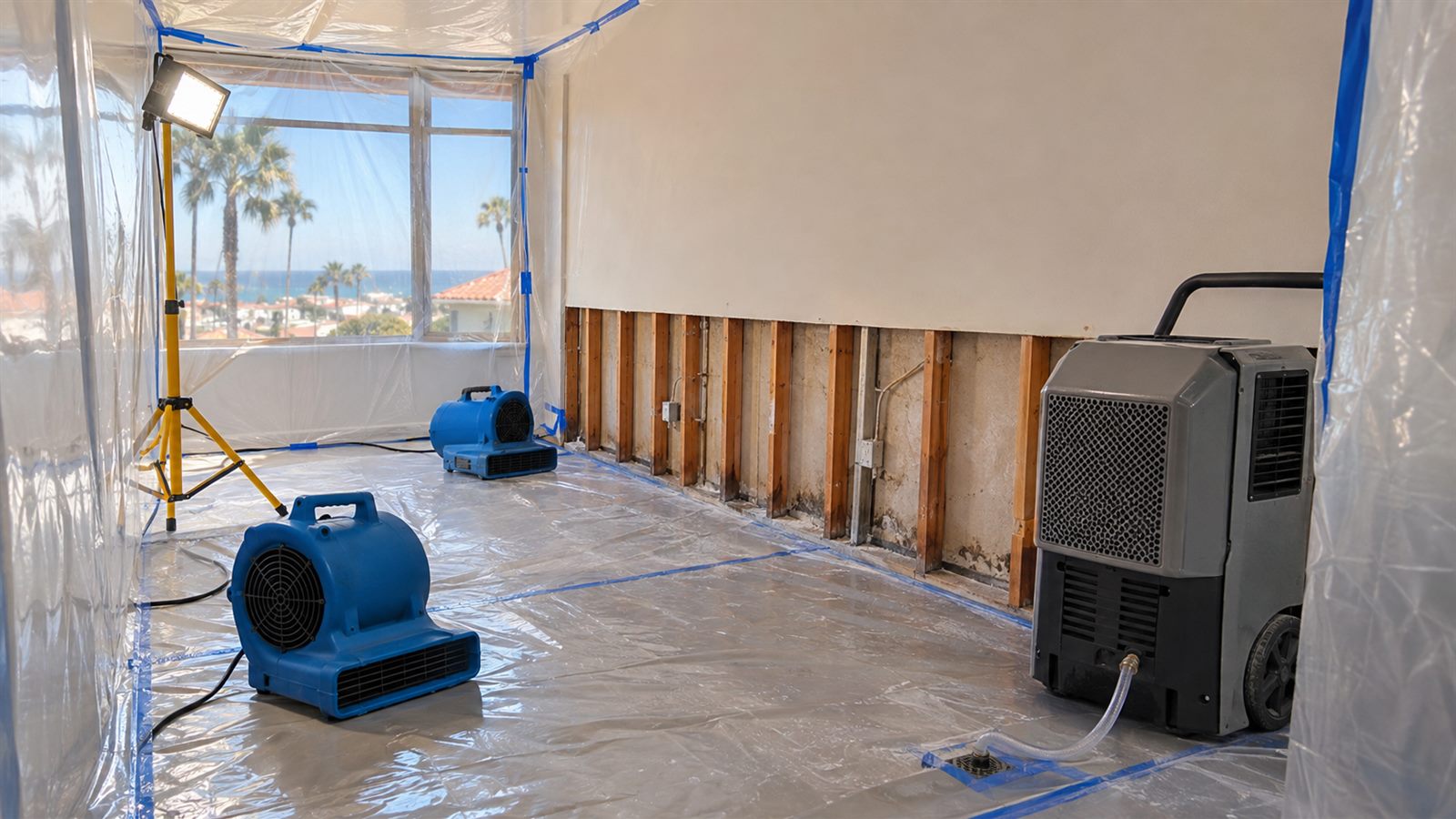
Most people ask about cost first and timeline second. In practice the timeline is what disrupts your life, and the single biggest variable is something nobody mentions: how humid the air outside is.
Quick answer
How long does mold remediation take? A single-room scope typically takes two to five days: one day for containment and removal, two to four days of drying with equipment running, then verification. Crawl space and attic work runs three to six days. Multi-room or multi-unit jobs run one to three weeks. Coastal San Diego addresses take longer than inland ones for the same scope, because humid make-up air slows drying and dehumidification has to run inside containment.
Timeline by scope
- Small contained area under 10 sq ft — 1 to 2 days.
- Single bathroom with wall and subfloor — 2 to 4 days.
- One room after a contained leak — 3 to 5 days.
- Crawl space with vapor barrier replacement — 3 to 6 days.
- Attic sheathing and insulation — 2 to 5 days.
- Slab-leak condition across flooring and wall bases — 4 to 8 days, and the slab itself is the slow part.
- Whole unit after a long-running loss — 1 to 3 weeks.
- Multi-unit building — 1 to 3 weeks depending on unit count and phasing.
These are remediation and drying only. Reconstruction — drywall, paint, tile, flooring, cabinetry — runs afterwards on its own schedule, typically another few days to several weeks.
Why drying is the long pole, not demolition
Demolition is fast. Containment goes up in a few hours and a room's worth of wet drywall and insulation comes out in a day. What takes time is getting the remaining material — framing, sheathing, subfloor, slab — down to a documented dry standard.
Drying is driven by the vapor pressure difference between the wet material and the air around it. The drier the air, the faster water leaves the material. That is why dehumidification matters more than fans, and why equipment has to run continuously rather than during working hours.
The San Diego variable: you cannot ventilate a coastal wall dry
In most of the country, drying can use outdoor air. In coastal San Diego from roughly May through September, outdoor morning relative humidity runs 80 to 90 percent, which means bringing that air into a wet assembly adds moisture rather than removing it.
So coastal jobs run closed-system dehumidification inside containment, which works but takes longer and needs more equipment than the same job in El Cajon or Poway. Practically, expect one to three extra days on a Mission Beach, Coronado or Ocean Beach job compared with an inland one of identical scope.
If a contractor proposes drying a beach-area wall with fans and open windows, they do not understand the local conditions.
What makes a job run over
- The source was not fixed first. If plumbing, roofing or drainage work has to happen mid-job, the schedule stretches by whatever that trade takes plus additional drying days.
- The boundary was larger than the initial scope. Once containment is up and material is open, the moisture map sometimes extends further than the pre-demolition readings suggested — most often in slab homes and in multi-storey assemblies where water travelled.
- Concrete. A slab saturated for months can need five to ten days of controlled drying, sometimes with specialised mat systems.
- Access. Occupied buildings, walk-street properties, high-rise logistics, HOA approvals and after-hours restrictions all add calendar time even where labour hours are unchanged.
- Verification failures. Rare, but if clearance does not pass, containment stays and additional work follows. Better found then than after the wall closes.
Can you stay in the house?
Usually yes. Containment with negative pressure and HEPA filtration is designed specifically so the rest of the building remains usable. Most of our residential work happens in occupied homes.
Relocation makes sense when the containment covers the only bathroom or kitchen, when the affected area is most of the home, or when an occupant is immunocompromised, severely asthmatic, pregnant, elderly or an infant. Equipment is also noisy — air scrubbers and dehumidifiers run 24 hours a day, which some people find harder to live with than the dust.
The reconstruction clock nobody quotes you
Remediation ends at verification: the assembly is clean, it is dry to a documented standard, and the equipment leaves. Most quoted timelines stop there. The household's timeline does not, because at that point there is an open wall, a missing floor or a ceiling with a hole in it, and putting those back is construction work on its own schedule.
Typical San Diego reconstruction windows. Drywall, tape, texture and paint on a single wall: three to five working days, most of it waiting for compound and paint to cure. A bathroom back to usable, including tile and a new pan: two to three weeks. Flooring across several rooms: one to two weeks once the material is on site. Cabinetry: four to eight weeks if anything has to be made rather than bought.
Three things that stretch it, specifically here. Matching an existing finish is the first — a 1960s knock-down texture, a discontinued tile, a hardwood that has aged twenty years. The second is permitting, which applies once structural framing or plumbing beyond a like-for-like repair is involved, and which runs on the city or county schedule rather than yours. The third is the insurance split: on a claim, remediation and reconstruction are frequently separate line items with separate approvals, and the second approval often waits on the first invoice.
What to ask before work starts. Who is doing the reconstruction and are they the same company. Whether their estimate is in the same document as the remediation scope. Whether the finish match has been confirmed or assumed. And whether anything in the scope needs a permit. Those four questions, asked on day one, are the difference between a three-week disruption and a three-month one — and they are the part of the timeline that is genuinely within your control.
Frequently asked questions
Can the job be rushed if I need the house back?
Demolition and cleaning can be staffed up. Drying cannot be rushed much beyond adding equipment, because it is governed by physics rather than labour. Additional dehumidifiers and specialised systems for slabs and hardwood can compress the schedule somewhat, at additional cost. What should never be compressed is the verification step — closing an assembly that has not reached the dry standard simply moves the problem to next year.
Why does equipment have to run overnight?
Because drying is continuous and stopping it lets material re-equilibrate with the surrounding air. Shutting dehumidifiers off at 5pm each day can add days to a job and in humid coastal conditions can effectively prevent it from finishing. If noise is a serious problem, tell us at the scoping stage and we will plan equipment placement and containment around it.
How soon can reconstruction start?
As soon as the affected materials reach the documented dry standard and verification passes — not before. The temptation to start drywall while the framing is still drying is strong, especially when a contractor is waiting. Resist it. A verified dry reading before close-up is also the document that protects you if anything is questioned later.
Can I stay in the house during remediation?
Usually yes, if containment is built properly and the affected area is not a bathroom or kitchen you cannot do without. Negative air pressure and HEPA filtration keep the work zone isolated. People generally move out when the work covers a main living area, when the only bathroom is involved, or when someone in the household has asthma or is immunocompromised.
Why is reconstruction not part of the timeline?
Remediation ends at verification — the point at which the assembly is clean and dry to a documented standard. Putting back drywall, texture, paint, tile and trim is construction work on its own schedule, and on an insurance claim it is often a separate line item with a separate approval.
Related reading
- mold remediation in San Diego
- mold removal cost in San Diego
- DIY vs professional mold removal
- San Diego mold services
Need help with this in San Diego? We provide Mold Remediation in San Diego across all 34 service areas. Free phone consultation, 24/7 — (858) 400-3506.