Mold Inspection vs Mold Testing: Which One Do You Actually Need?
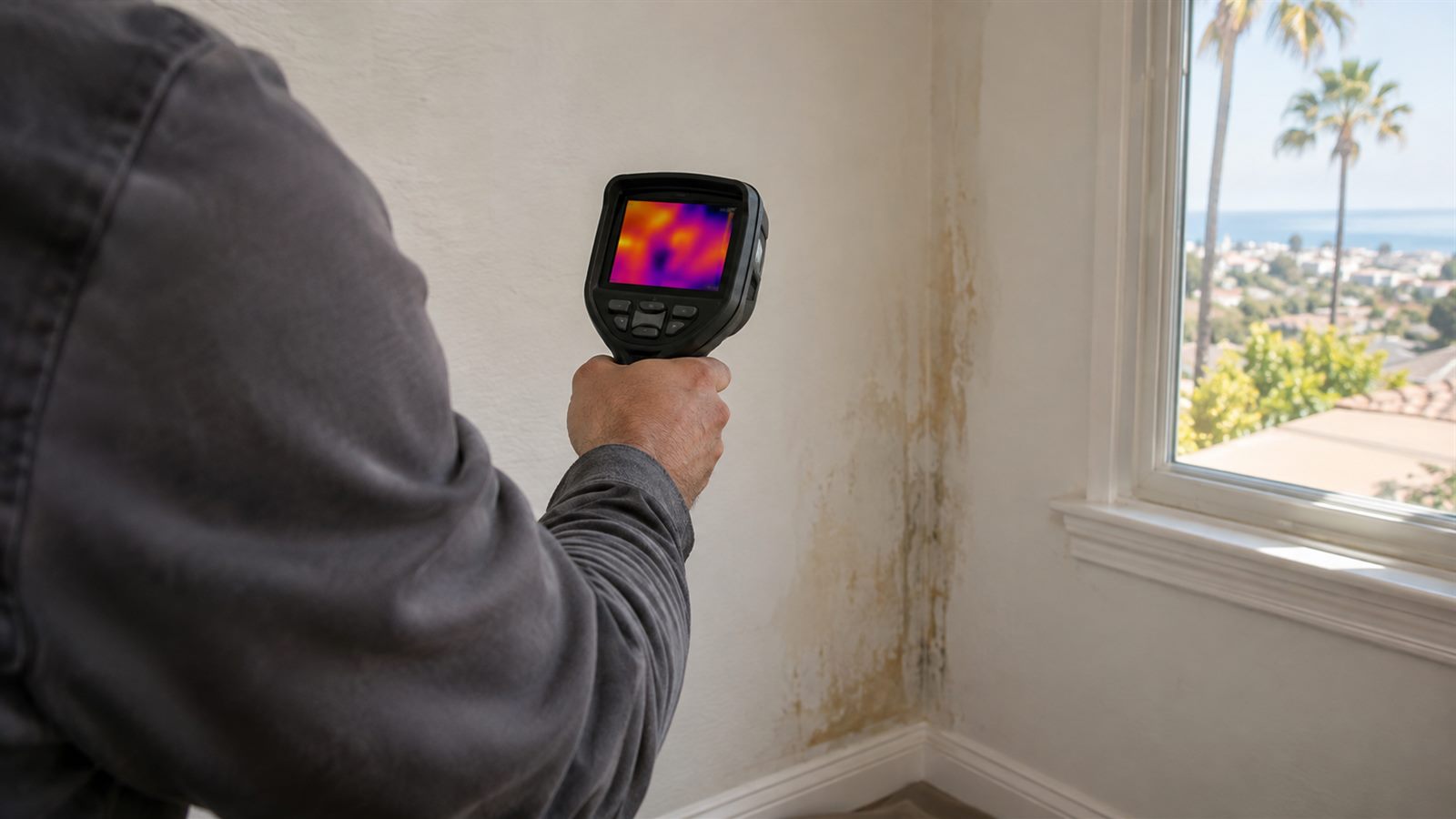
These are two different purchases that get sold as one. Buying the wrong one is the most common waste of money in this field, and the industry is not especially motivated to explain the difference.
Quick answer
What is the difference between a mold inspection and mold testing? An inspection answers where is the water and where is the growth, using moisture meters, thermal imaging, hygrometry and cavity access. Testing answers what species are present and in what quantity, using air or surface samples analysed by a laboratory. The inspection determines the scope of work; the testing usually does not, because the remediation protocol is the same for most species. You almost always need the inspection and only sometimes need the testing.
What an inspection actually does
A proper mold inspection takes 60 to 90 minutes for a typical home and produces a written record. It covers the interview and water history, an exterior assessment (grade, drainage, roof-to-wall junctions, window head flashing, foundation vent clearance), an interior room-by-room survey, moisture mapping with pin and pinless meters against an established dry standard, thermal imaging, indoor and outdoor psychrometric readings, borescope access into cavities where needed, and assessment of the crawl space, attic and HVAC system.
The output is a source determination, a moisture map and a recommended scope. That is the thing that decides what the work costs. In San Diego it runs $250 to $600.
What testing actually does
Testing takes a physical sample and sends it to a laboratory. There are four methods and they answer different questions.
- Spore-trap air sampling — air drawn through a cassette for a measured period; the lab counts and identifies spores by genus. Must be paired with a simultaneous outdoor control sample or the number means nothing. $100 to $200 per sample including lab.
- Tape lift or swab — tells you whether a specific visible discoloration is mold and which genus. Cheap and definitive for that surface only. $75 to $150.
- Bulk sampling — a piece of the material itself. Mostly useful for documenting extent in a claim or a legal matter.
- Cavity air sampling — drawn from inside a wall or floor assembly through a small penetration. This is the one that answers “I smell it but I cannot see it,” and in San Diego's stucco-over-frame and raised-floor construction it is often the most useful sample you can buy.
Why testing usually does not change the work
The California Department of Public Health's guidance on dampness and indoor mold is that visible mold and the dampness causing it should be addressed regardless of the species present, because the adverse health effects are associated with dampness and mold generally rather than with any one organism. The US EPA takes the same practical position.
Operationally that means the containment design, the removal boundary, the drying standard and the verification method do not change based on whether the lab reports Stachybotrys, Aspergillus, Penicillium or Cladosporium. If mold is visible and you know where the water came from, a species panel is information you are paying for and will not act on.
The four situations where testing is worth it
- You can smell it but cannot find it. Cavity air sampling plus moisture mapping locates hidden growth without exploratory demolition. This is the best-value use of testing in San Diego.
- There is a dispute. Landlord, insurer, HOA, buyer or seller. A lab report from an accredited laboratory with documented chain of custody, paired with moisture readings, converts an argument into evidence.
- Someone is symptomatic. Asthma, persistent cough, infants, elderly or immunocompromised occupants. A baseline spore count with an outdoor control gives you something to measure improvement against.
- Clearance after remediation. Independent post-remediation verification before assemblies are closed — ideally by a party that did not do the remediation.
How to read a lab report without being misled
There is no federal or California numeric standard for acceptable indoor mold spore counts. Anyone who hands you a number and calls it a pass or fail against a standard is overstating what the test can do.
Interpretation is comparative. Indoor counts should be similar to or lower than the simultaneous outdoor control, and the indoor profile of genera should broadly resemble the outdoor one. Indoor counts substantially above outdoors, or an indoor profile dominated by genera that are not prominent outside, indicates an indoor source. Marker genera such as Stachybotrys or Chaetomium indicate prolonged wetting of cellulose.
A sample taken without an outdoor control on the same day is close to uninterpretable.
About free inspections and home test kits
Free inspections. A free phone consultation is genuinely free and worth taking. A free full on-site inspection with instruments and a written report generally is not — it is two hours of skilled labour plus equipment, and where it is offered by a remediation company it is a sales visit. That can be perfectly fine as long as you know it. If you need a document that will stand up with an insurer, a landlord or a buyer, pay for the inspection and own the report.
Home test kits. Settle-plate kits will grow something almost anywhere, because spores exist in every building, and they provide no quantitative comparison against outdoor air. They reliably produce a frightening result and no actionable information.
How to judge the report you paid for
The deliverable is what you are buying, and it is the fastest way to judge whether $250 to $600 was well spent. A report worth the fee contains all of the following.
A water history. What the occupants observed, when, and what has been repaired before. Half of all source determinations come out of the interview rather than the instruments.
An exterior assessment. Grade and drainage for the first six feet, downspout discharge, weep screed clearance, roof-to-wall junctions and kick-out flashing, window head details, penetration sealant condition. A report that never went outside cannot have found an envelope defect.
Moisture readings against a stated dry standard taken from unaffected material of the same type in the same building, with the locations mapped and photographed. Raw numbers with no standard to compare them against mean nothing.
Psychrometric readings indoors and outdoors, at the same time — temperature, relative humidity, dew point. This is what distinguishes a humidity problem from a leak.
A source determination, or an explicit statement that the source was not found and what would be needed to find it. “Elevated moisture noted” with no hypothesis is not a determination.
A recommended scope. What comes out, what gets cleaned, what dries, and to what standard.
Two warning signs. A free inspection from a company that will also do the remediation is a sales visit with instruments, and the incentive runs toward a larger scope; it is not disqualifying, but the report should still contain everything above. And an inspection that recommends air sampling before any source has been identified is usually selling the sample.
Who to hire, and the conflict of interest to watch for
California does not license mold inspectors as a distinct trade. What exists instead is a set of relevant credentials and a licensing question about the work that follows.
Credentials worth asking about: IICRC certification in applied microbial remediation or water restoration, a Certified Indoor Environmentalist or Council-certified Indoor Environmental Consultant designation, or an industrial hygienist qualification for complex and contested matters. For the remediation and reconstruction that follows, a Contractors State License Board licence is the thing to verify, and you can check its status and any disciplinary history yourself on the CSLB register in under a minute.
The structural conflict is worth naming plainly. A company that inspects, tests, remediates and rebuilds has a financial interest in the size of the scope it writes for itself. That is not a reason to avoid them — integrated crews often sequence the work better and cost less overall — but it is a reason to read the moisture map against the proposed removal boundary, and on a large or contested job a reason to consider an independent assessor whose only product is the report.
Frequently asked questions
Should the company that tests also do the remediation?
For a straightforward job where mold is visible and the source is obvious, one company inspecting, scoping and remediating is efficient and the conflict is small. For a disputed claim, a legal matter, a large loss or final clearance after major remediation, independent third-party testing is the right call. A reputable contractor will tell you which situation you are in.
Can a home inspector do this?
A general home inspector will note visible staining and obvious suspect growth, which is valuable, but a standard home inspection does not include moisture mapping to a dry standard, thermal imaging interpretation, psychrometric analysis, cavity access or sampling. In San Diego that gap matters, because the common failure modes — slab leaks under flooring, water travelling inside stucco walls, blocked crawl space ventilation, bathroom fans terminating in attics — are all invisible to a visual inspection.
How long do lab results take?
Two to five business days from an accredited fungal laboratory, with 24-hour and same-day rush available at a premium. Rush is worth it when a real estate contingency period or a habitability deadline is running. Chain of custody should be documented if the result might ever be used in a dispute.
Is a free mold inspection worth having?
It can be, but understand what it is: a company that will also bid the remediation, assessing whether there is remediation to bid. Judge it on the deliverable — exterior assessment, mapped moisture readings against a stated dry standard, psychrometrics and a source determination. If those are present, the price was good. If it is a verbal recommendation and a quote, you have a sales visit.
Can I skip the inspection and go straight to remediation?
Only when the source is already known and corrected and the growth is visible and limited — a shower wall after a fixed leak, say. Where the source is unknown, remediation without an inspection means guessing at the removal boundary, and a boundary guessed short is the most reliable way to pay for the same wall twice.
Related reading
- mold inspection and testing in San Diego
- mold removal cost in San Diego
- signs of hidden mold
- types of mold in San Diego homes
Need help with this in San Diego? We provide Mold Inspection and Testing in San Diego across all 34 service areas. Free phone consultation, 24/7 — (858) 400-3506.