Mold After a Roof Leak in San Diego: What to Do and How Long You Have
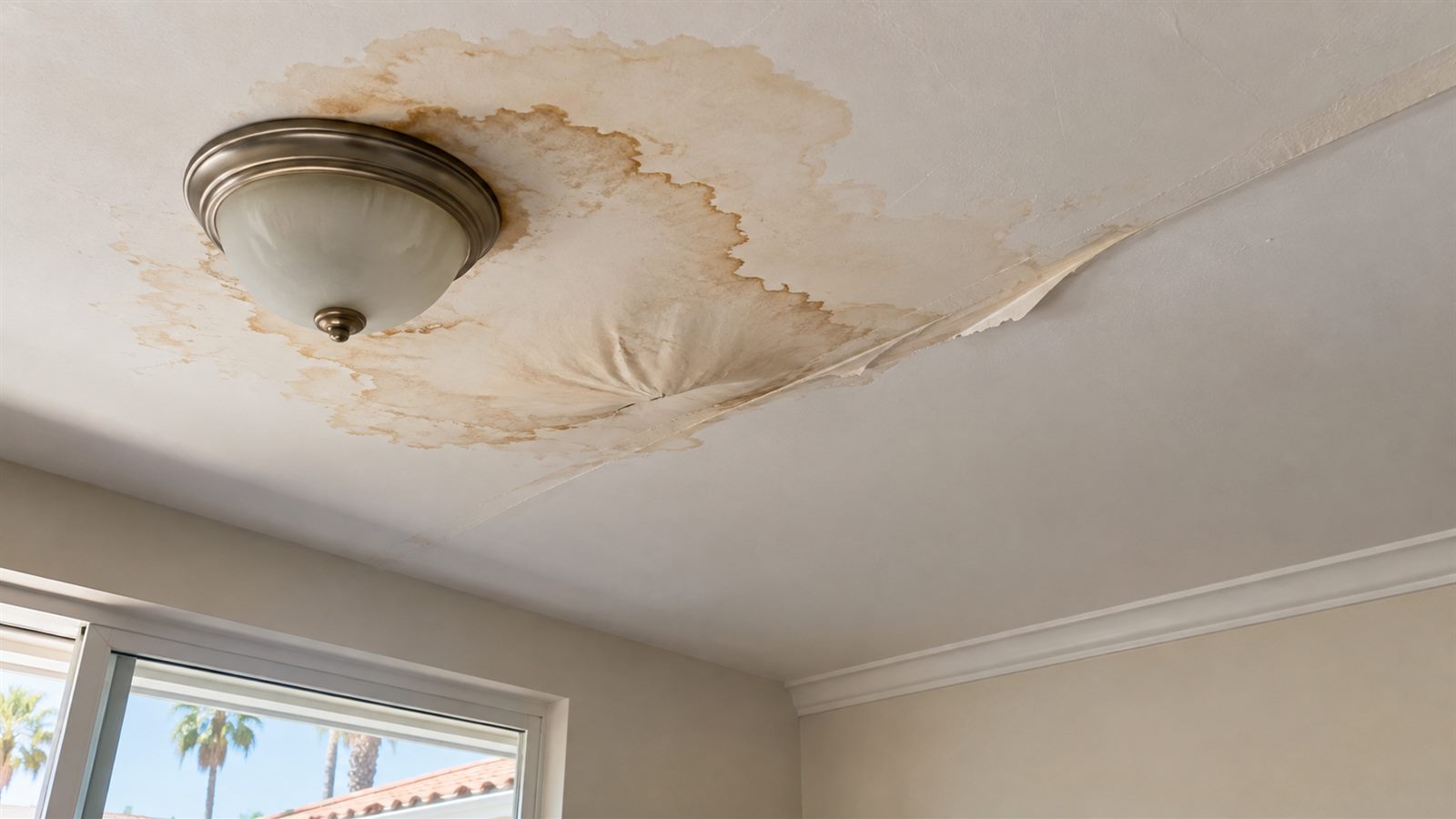
A ceiling stain after a storm looks like a small problem. The water that made it has usually been in the insulation and the framing for longer than the stain has existed.
Quick answer
What should I do after a roof leak? Contain the water, photograph everything, and get the assembly opened and dried within 24 to 48 hours. Put a container under an active drip and, if a ceiling is bulging, relieve it with a small hole at the low point so water drains in one place instead of collapsing the ceiling. Then have the attic and the ceiling cavity assessed with a moisture meter — wet insulation and sheathing do not dry on their own and will grow mold within two days.
Why the stain is rarely under the hole
Water entering a roof assembly runs along the underside of the sheathing, down rafters, across the top plate and along ceiling joists before it finds a penetration to come through — a light fixture, a seam in the drywall, a nail line. In a two-storey home it can enter a wall cavity and surface on the floor below.
So the ceiling stain marks the exit, not the entry. Patching the roof directly above a stain is one of the most common wasted repairs in this trade. The assessment has to work backward from the wet footprint in the attic, not forward from the stain.
What is actually wet, and why it does not dry
Three materials hold the water and none of them dry well on their own.
- Insulation. Fibreglass batt and blown cellulose soak up and hold water, lose their R-value, and sit directly on the ceiling drywall. Wet insulation is the main reservoir after a roof leak and it is the main reason ceilings grow mold above the visible stain.
- Sheathing and framing. Plywood or OSB deck and the rafters beneath it. In an attic with poor ventilation — which, after re-roofs and insulation upgrades, is most San Diego attics — these stay wet for weeks.
- Ceiling drywall. Once saturated, gypsum loses strength and the paper facing is an ideal mold substrate. A stained, sagging or soft ceiling panel is replaced rather than dried.
Mold colonises wet gypsum and insulation within 24 to 48 hours. In a San Diego attic in a warm week, faster.
What to do in the first hours
- Photograph everything before you move or touch anything, including the attic if you can get up there safely.
- Contain the drip with a bucket and move contents out of the way.
- If the ceiling is bulging, relieve it. A small hole at the low point with a screwdriver lets water drain in a controlled place instead of bringing the whole panel down. This feels wrong and it is the right move.
- Do not put a bucket in the attic and walk away. The water is already in the insulation.
- Tarp the roof if the weather is continuing and it can be done safely. Otherwise leave it to someone with the equipment — wet San Diego tile is genuinely dangerous.
- Call for assessment within a day, not after the storm cycle passes.
The sequence that prevents a repeat
- Moisture map from the attic. Find the full wet footprint on the sheathing, rafters, insulation and top of the ceiling, and trace it back to the entry point.
- Remove wet insulation. It does not recover and it keeps everything around it wet. This is almost always necessary and almost always skipped in a quick repair.
- Remove compromised ceiling drywall — stained, soft or sagging.
- Dry the sheathing and framing with dehumidification, measured against a dry standard, not until it looks dry.
- Treat any growth on sheathing and framing: HEPA vacuum, damp wipe, abrade where it has penetrated the wood.
- Fix the roof properly, from the real entry point rather than from the stain.
- Check attic ventilation while you are up there. If intake at the soffits is buried under blown insulation or exhaust was lost during a re-roof, the attic cannot dry itself and the next leak will be worse. See attic mold removal.
- Replace insulation last, after verification. Installing insulation into a damp attic seals the problem in.
San Diego roof specifics worth knowing
- Tile outlasts its underlayment by decades. Concrete and clay tile can look perfect for fifty years while the felt beneath it has failed. The first symptom is often attic sheathing mold with no visible roof defect at all.
- Canopy debris blocks valleys. In Scripps Ranch, Leucadia, La Mesa Village and North Park, eucalyptus and street-tree litter backs water up under the roofing at valleys. Clearing them annually is the single best roof maintenance item in those neighborhoods.
- Salt corrodes fasteners and flashing. Within a few hundred yards of the surf, galvanized roof fasteners and flashing corrode fast. Fasteners back out and open the deck; vent screens rust through and let wind-driven rain in.
- Abandoned evaporative cooler penetrations. In East County, a decommissioned cooler often leaves an opening that was capped poorly or not at all.
Telling a roof leak from the thing that is usually mistaken for one
Most calls about attic mold in San Diego are not roof leaks, and the pattern of the staining tells you which you have before anyone goes on the roof.
A roof leak radiates from a point. There is a wettest spot, usually at a penetration — a vent stack, a skylight curb, a chimney, a valley, a satellite mount — and the staining fans out and downward from it. Follow the darkest point upslope and the defect is above it.
Condensation spreads evenly. Diffuse grey-black growth across the underside of the deck, often heaviest on the north slope and in the corners furthest from the vents, with no single origin. That is not water from outside. It is interior moisture meeting a cold deck, and in this county the cause is a bathroom fan or dryer terminating in the attic, or soffit intake vents buried under blown insulation.
The distinction decides the money. Remediating condensation staining without fixing the duct or the ventilation guarantees a repeat within a season, and a new roof fixes nothing at all.
Why the ceiling stain is not where the leak is
Water that gets through a roof lands on the top of the sheathing or runs along a rafter, and then it travels. On a sloped deck it runs downslope until a nail, a joint, a truss plate or a run of insulation stops it; then it drips. The visible ceiling stain is at the drip point, which can be many feet from the entry, and in a complex 1990s roof it can be in a different room.
Two consequences. Opening the ceiling under the stain tells you about the drip point rather than the defect, so the diagnostic order is attic-first: get above the stain, follow the staining on the deck upslope in daylight with a torch, and find the penetration. And a hose test on the suspected detail, run from below the detail upward in sections, reproduces the condition instead of guessing — which matters here because many San Diego roof defects only leak under wind-driven rain and will not reproduce with a gentle flood.
The four-week check that decides whether you got away with it
San Diego's rain arrives in a handful of storms, so a roof leak is usually a single event rather than a continuing condition. The surface dries, the stain stops growing, and the household concludes it is over. Insulation, sheathing and framing dry far more slowly, and wet cellulose is colonised within 24 to 48 hours.
So mark a date four weeks out and check three things. Does the stain reappear or darken? If so, the material behind it is still wet and the organism is alive. Is there a smell in that room that was not there before, strongest in the morning or when the HVAC starts? Does a moisture meter on the ceiling or the wall below still read above the dry standard elsewhere in the same room?
Any one of those at four weeks is far cheaper to act on than the same finding at six months, which is when the insulation has matted, the framing has stained and the scope has grown from a section of ceiling to a room. It is also, on an insurance claim, still close enough to the storm to be argued as a sudden event rather than long-term seepage.
Frequently asked questions
The ceiling dried out by itself. Do I still need to do anything?
Probably yes. A ceiling surface dries long before the insulation above it does, because the insulation has no airflow and is sandwiched between drywall and a cool roof deck. The quick check is to get into the attic and feel or meter the insulation directly above the stain. If it is damp, or if it is matted and compressed, it held water and needs to come out. A stain that reappears or spreads after drying is a certainty that something is still wet.
Will insurance cover a roof leak and the mold from it?
A storm-driven breach — wind lifting or damaging roofing, creating an opening — is generally covered, including the resulting water damage and usually the mold as ensuing damage, often sublimited. A leak from a worn-out roof that simply reached the end of its service life is generally excluded as maintenance. That distinction is made from the physical evidence, which is one more reason to photograph the roof and the attic before anything is repaired.
Should I replace the roof or just repair it?
That is a roofer's call, but the relevant inputs are the age of the underlayment rather than the tile, how many separate leak locations have appeared, and whether the attic shows a single wet footprint or several. Multiple independent leaks in one winter on a tile roof usually indicates underlayment at end of life, in which case repeated repairs are throwing money at a system that needs replacing.
My ceiling stained once and never again. Do I need to do anything?
Check it at four weeks. Surfaces dry long before insulation, sheathing and framing do, and wet cellulose is colonised within 24 to 48 hours. A stain that darkens or returns, a new smell in that room, or an elevated meter reading at four weeks all mean the assembly never dried.
Does my attic mold mean I need a new roof?
Often not. Diffuse grey-black staining spread evenly across the deck is condensation, usually from a bathroom fan ducted into the attic or from blocked soffit vents — a ventilation repair, not a roof. A roof leak radiates from a point, and the defect is at the penetration above that point.
Related reading
- attic mold removal in San Diego
- water damage restoration in San Diego
- stucco moisture intrusion in San Diego
- mold removal Scripps Ranch
Need help with this in San Diego? We provide Attic Mold Removal in San Diego across all 34 service areas. Free phone consultation, 24/7 — (858) 400-3506.