Stucco Moisture Intrusion in San Diego: Why the Stain Is Never Where the Leak Is
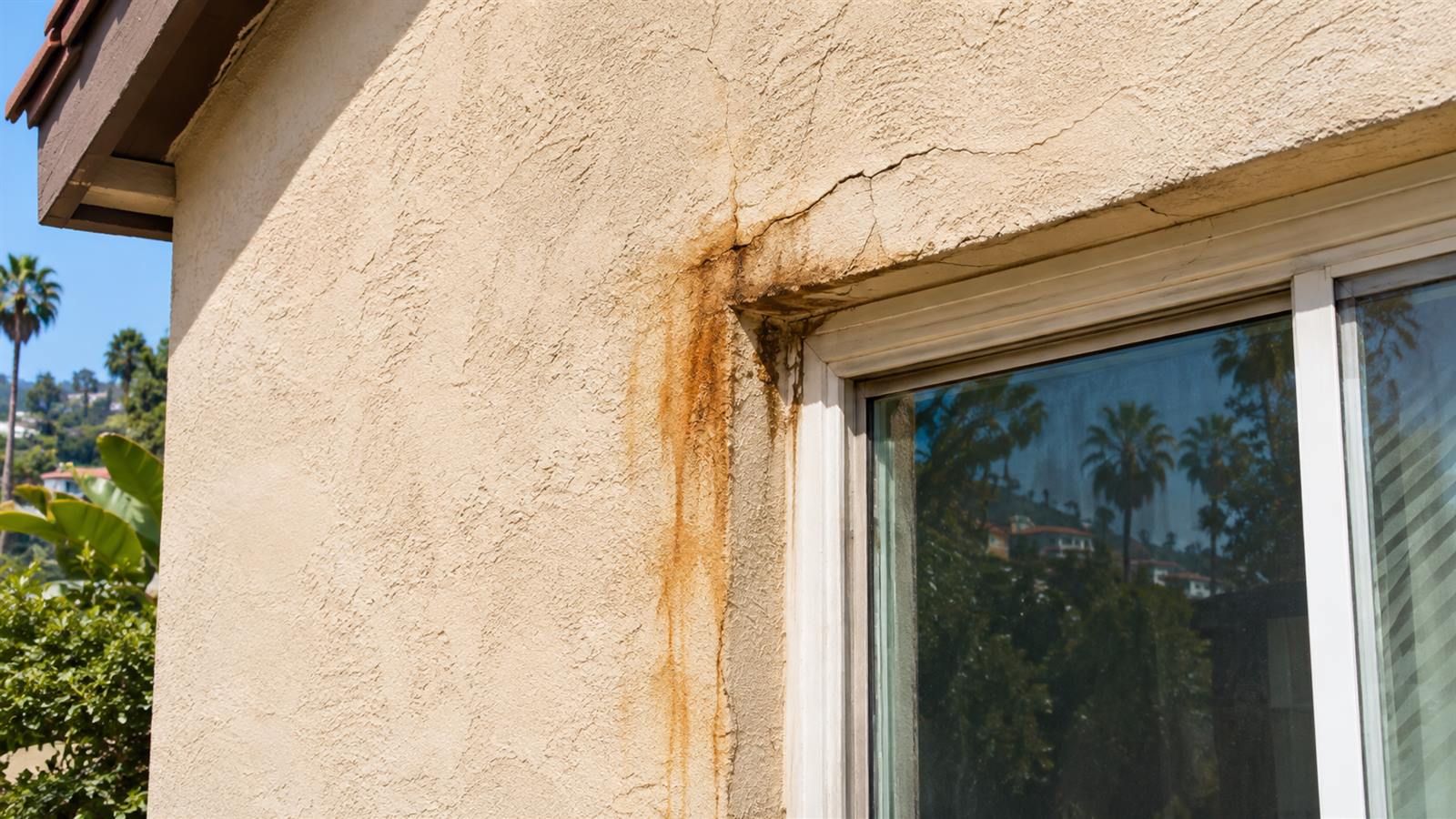
Stucco over wood frame is the dominant exterior assembly in San Diego, and it is very good at hiding where water got in. Open the wall at the stain and you will usually miss the problem entirely.
Quick answer
Why does stucco cause hidden water damage? Stucco is a reservoir cladding: it absorbs water and holds it, and the assembly depends on a drainage plane and flashings behind it to get that water back out. When a flashing detail fails or was never installed, water enters the wall cavity and runs down the framing until something stops it — a plate, a header, a floor assembly. The interior stain appears at that stopping point, which can be one or two floors below the actual entry.
How a stucco wall is supposed to work
Stucco is not a waterproof barrier and was never intended to be. It absorbs water in rain, holds it, and releases it over time. The system behind it is what keeps the building dry: a water-resistive barrier forming a drainage plane, a drainage gap, weep screed at the base, and flashings at every penetration and transition to carry water back out to the face.
When those work, the wall gets wet and dries. When one detail fails, water enters the cavity and the stucco that is so good at holding water now keeps that cavity wet long after the rain stops.
Failure one: missing kick-out flashing
This is the most consequential detail omission in San Diego production housing from the 1990s and 2000s, and we find it constantly in Encinitas Ranch, Carlsbad's La Costa and Aviara, San Marcos, Chula Vista's Eastlake and Otay Ranch, and Oceanside's Rancho del Oro.
Where a roof edge terminates against a vertical wall, a small metal diverter — a kick-out — is needed to throw the runoff out into the gutter. Without it, every rain event sends a concentrated stream of water down the roof edge and straight behind the stucco at that junction.
The volume is the issue: it is not a drip, it is the drainage of a whole roof plane concentrated at one point. On a two-storey home the resulting interior damage commonly appears on the ground floor, a full storey below the junction.
Failure two: corroded window head flashing
This is the coastal version. Within a few hundred yards of the surf, chloride-laden fog corrodes galvanized flashing, fasteners and drip edges at an accelerated rate. The flashing above a window perforates, the sealant joint fails, and water enters at the head and runs down inside the wall.
Interior staining typically appears two to four feet below the window head, which is why homeowners and even some contractors conclude the sill is leaking. It almost never is. In La Jolla, Bird Rock, Windansea, Coronado, Mission Beach and Sunset Cliffs, the first place we look on an unexplained interior stain is the window head above it.
The other recurring entry points
- Weep screed buried by hardscape or soil. The weep screed at the base of a stucco wall is how drained water exits. Raise the grade, pour a patio against the wall, or build a planter bed over it, and water has no way out — it wicks upward into the framing instead. Extremely common after landscaping work.
- Penetrations without flashing. Hose bibs, electrical boxes, light fixtures, satellite mounts, vent terminations, and in East County abandoned evaporative cooler openings. Each one is a hole; sealant alone is not a flashing and fails within a few years.
- Deck and balcony to wall transitions. Where a deck ledger or a waterproofed deck meets a stucco wall. Widespread in Mission Beach, Pacific Beach and coastal multi-level homes.
- Cracks at stress points. Stucco cracks at window and door corners are normal; what matters is whether the drainage plane behind is intact. Sealing surface cracks without addressing flashing can make things worse by trapping water in.
How to inspect it properly
Start outside and above, not inside at the stain.
- Find every roof-to-wall junction and check for a kick-out diverter at the bottom end.
- Look at the window and door heads above the interior damage, particularly on west and south elevations and anywhere within sight of the surf.
- Check whether the weep screed is visible at the base of the wall, with clearance, or buried under soil, concrete or a planter.
- Note every penetration and whether it has a flashing or just a bead of sealant.
- Then moisture map inside, upward and outward from the stain, to establish the actual wet column.
Thermal imaging helps a great deal here, and so does timing: inspect during or within a day of rain if you can, because a stucco wall that has dried for three weeks shows much less.
The four places San Diego stucco actually fails
Stucco itself is not waterproof and was never meant to be. It is a cladding over a water-resistive barrier, and the system works as long as water that gets behind the stucco can drain back out. Every common failure is a drainage failure at a detail, not a failure of the stucco field.
Window and door head flashing. The single most common defect in 1970s and 1980s stucco-over-frame construction, and the reason a wall can be dry for eight months and take water in one February afternoon. Wind-driven rain is pushed up and under a head detail that relies on sealant rather than a flashing pan.
Missing kick-out flashing where a roof meets a wall. Where a sloped roof terminates against a vertical stucco wall, the gutter line has to be diverted away from the wall. Without that small piece of metal, the whole roof plane drains into the wall assembly. Extremely common in 1990s and 2000s homes with complex roof geometry.
Weep screed buried by hardscape or soil. The bottom edge of a stucco wall has a screed that lets drained water escape. Raise the patio, add a planter bed or build up the grade and that outlet is sealed; water that enters at a window above then has nowhere to go but into the framing.
Penetrations added after the fact. Hose bibs, light fixtures, satellite mounts, condenser lines and security cameras drilled through a finished wall and sealed with caulk. Caulk has a service life of five to ten years in coastal UV; the hole does not.
Why the damage shows up nowhere near the entry point
Water behind stucco runs down the water-resistive barrier until something stops it. That something is usually a horizontal framing member, a shelf angle, a window sill below, or a band of blocking. So a head-flashing defect above a second-storey window produces swollen baseboard on the ground floor, eight feet to the left, and the owner spends months looking for a plumbing leak.
Three consequences. First, a visible stain is a poor guide to the source; the entry point is almost always above it and often laterally offset. Second, the honest diagnostic sequence is exterior-first — assess the elevation, the penetrations and the flashing details before opening interior finishes. Third, a hose test from the bottom up, section by section, is worth more than any amount of interior demolition, because it reproduces the condition instead of guessing at it.
What to check after a storm, and what to ask a specialist to do
Walk the exterior while it is still wet. Dark patches on stucco that are slow to dry mark saturated areas. Photograph them — they are invisible a day later.
Look at the inside of exterior walls below every window, particularly on west and south elevations, and at the bottom twelve inches of walls where a roof meets a wall above.
Check for bubbling or blistering paint on the stucco itself. That is moisture moving out through the substrate from behind, not a paint defect.
Ask for an exterior assessment before any interior opening. Grade, drainage, weep screed clearance, roof-to-wall junctions, window head details, penetration sealant condition. Then moisture mapping from inside against a dry standard, and a hose test on the suspect detail. A specialist who wants to open drywall before walking the elevation is working backwards.
Frequently asked questions
Should I seal or paint my stucco to stop leaks?
Be careful. An elastomeric or vapor-impermeable coating applied over stucco can trap moisture inside the assembly, because the wall needs to dry outward as well as drain. We are regularly called to problems made worse by a sealing job. Painting is fine with an appropriately permeable product; sealing as a substitute for fixing flashing is not. Fix the detail that is letting water in.
How much does kick-out flashing cost to add?
Typically a few hundred dollars per junction when done as part of roof or gutter work, because it requires lifting roofing material at the edge and integrating the diverter with the wall's drainage plane. Against a $3,000 to $8,000 interior remediation for a wet column inside a two-storey wall, it is among the best-value preventive items on a 1990s or 2000s San Diego home.
Does this affect older stucco homes too?
Yes, differently. Pre-1950 San Diego stucco is typically applied over wood lath with building paper, and the failure modes are corroded flashings, buried weep details after decades of landscaping, and penetrations added over the years with no flashing. Older assemblies also tend to be more vapor-open, which helps them dry, but they have had far more time to accumulate unflashed penetrations.
Will repainting or sealing my stucco stop water getting in?
No, and an impermeable coating can make it worse. Stucco has to be able to dry outward; seal the field and water that enters at a window or a penetration is trapped in the framing. The fix is always at the detail — flashing, weep screed clearance, penetration sealant — not across the wall.
Why does my stucco wall only leak in some storms?
Because the common defects need wind as well as rain. A head-flashing gap or an unsealed penetration takes water when rain is driven sideways against that specific elevation. A calm two-inch rain can do nothing while a wind-driven one-inch rain from the south soaks the wall.
Related reading
- mold inspection and testing in San Diego
- mold remediation in San Diego
- mold removal Encinitas
- mold after a roof leak in San Diego
Need help with this in San Diego? We provide Mold Inspection and Testing in San Diego across all 34 service areas. Free phone consultation, 24/7 — (858) 400-3506.