Still Smelling Mold After the January 2024 San Diego Flood? Here Is Why
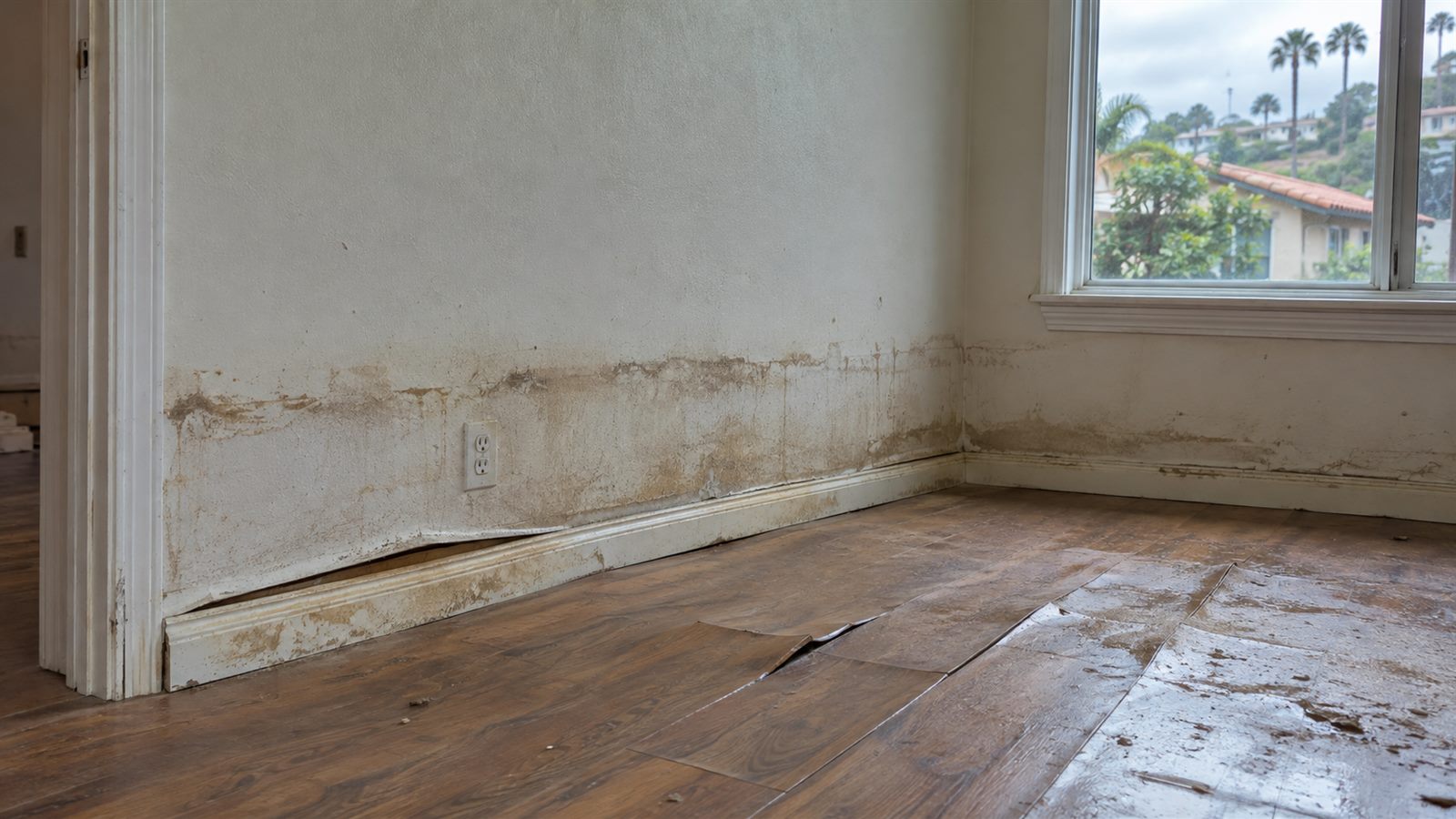
Flood water is contaminated, which means affected porous material has to be removed, not dried. A great many of the repairs done after the January 2024 storm dried the surface and covered the problem.
Quick answer
Why does my house still smell of mold after flooding? Almost certainly because porous material that should have been removed was dried in place and covered. Flood water is category 3 — contaminated — so the correct protocol removes drywall to above the water line, all wet insulation, carpet and pad, and particleboard cabinetry rather than attempting to dry them. Where finishes were reinstalled over material that was never removed, mold grows inside the assembly and the smell is often the only symptom.
What happened, and where
The January 2024 storm produced record rainfall for a single January day at San Diego and overwhelmed storm drainage across the low-lying parts of the county. Water entered homes in southeastern San Diego along the Chollas Creek corridor, in National City, in western Chula Vista, in Lemon Grove, in parts of Mission Valley and in low blocks elsewhere.
Thousands of properties took water, many of them older rental housing. The repair wave that followed was fast, large and uneven, and a substantial share of it did not follow the protocol that contaminated water requires.
Why flood water changes everything
Water losses are classified by contamination. Category 1 is clean supply water. Category 2 is grey water with significant contamination. Category 3 is grossly contaminated — sewage, sewer backup, and river, storm and ground surface water.
All flood water is category 3 by definition, because it has travelled across streets, through yards, past storm drains and often mixed with sewer overflow. It carries bacteria, chemical contamination and silt.
The protocol difference is absolute. With category 1 water caught early, carpet, pad, drywall and insulation can often be dried in place. With category 3, those materials are removed, the structure is cleaned and disinfected, and only then is it dried. Drying contaminated material does not decontaminate it.
What a correct flood repair looks like
- Drywall cut and removed to at least 12 to 24 inches above the visible water line, and higher where readings indicate wicking.
- All wet insulation removed — batt insulation holds water and contamination indefinitely.
- Carpet and pad removed and disposed of. Pad is never salvageable in category 3.
- Particleboard and MDF cabinetry, vanities and shelving removed. These swell and delaminate and cannot be cleaned.
- Framing, sheathing and slab HEPA-vacuumed, cleaned and treated with an EPA-registered antimicrobial.
- Structural drying with dehumidification and documented daily moisture readings until the dry standard is reached.
- Verification before any reconstruction.
What a shortcut repair looks like
Fans run for a few days. Carpet pulled but pad left or replaced over a damp slab. Drywall left in place because it “dried out.” Baseboard reinstalled. Fresh paint. Done in a week.
The surface looks fine. Inside the wall, the bottom of the drywall and the insulation behind it stayed wet and contaminated, and growth established within days. Eighteen months later the only symptom is a smell that will not go away, and perhaps allergy-type complaints in the household.
We open these walls regularly in National City, western Chula Vista and the Lemon Grove and Chollas Creek corridors.
How to find out what is actually in your wall
You do not have to guess, and you do not have to demolish to find out.
- Moisture mapping. Pin and pinless meters along the base of every wall that took water, compared against an unaffected dry standard. Material that is still elevated eighteen months later means it was never dried.
- Thermal imaging across the affected elevations to show the wet footprint.
- Cavity air sampling through a small patchable penetration, which directly answers whether there is growth behind the new paint.
- A borescope look inside the wall at the base, which often settles it visually in thirty seconds.
An inspection of this kind runs $250 to $600 and either gives you peace of mind or tells you precisely what has to be redone.
Insurance, and the hard part
Standard California homeowners policies do not cover surface flooding at all. Flood coverage requires a separate NFIP or private flood policy, and in the 2024 event many affected households did not have one.
Where there was flood coverage, re-opening a claim for inadequate repair is difficult but not impossible — it depends on the policy, the timeline and what was documented. Where the repair was performed by a contractor, a claim against that contractor's work may be the more realistic route, and for that you need a written technical finding rather than a complaint. We produce the documentation; we do not pursue the claim. See does insurance cover mold removal in California.
Why so many of those repairs failed, in one technical distinction
The January 2024 storm put record water into Chollas Creek, the San Diego River corridor, Southcrest, Shelltown, Mountain View, National City and western Chula Vista. Water that arrives from outside a building is Category 3 under IICRC S500 — it has contacted soil, street surfaces, sewers and whatever else was in its path — and for Category 3 the standard is removal of affected porous material, not drying it in place.
A great many of the repairs done in the weeks after that storm dried carpet, pad, drywall and insulation that should have been removed. The reasons were understandable: crews were overwhelmed, households were displaced and desperate to move back, and drying is cheaper and faster than demolition. The outcome was predictable. Material that was contaminated rather than merely wet was sealed back up, and the recurrence showed up over the following months as returning stains, persistent smell and growth at wall bases.
If your home was in one of those corridors and the repair consisted of fans and a dehumidifier with the drywall left in place, that is the single most useful fact to know about your building.
What to check now, nearly two years on
The bottom twelve inches of walls in affected rooms. Press the drywall above the baseboard. Softness, a tide-line, separation at the baseboard or paint that lifts means the material is still carrying moisture or was never replaced.
Under the flooring, if you can get a look. At a vent register, a door threshold or behind a cabinet toe-kick. Cupping, lifting, a sour smell, or a dark line on the subfloor edge.
Whether the pad was replaced, not just the carpet. Carpet pad is the single most reliable place for contamination from flood water to persist, and replacing the carpet over the original pad was common.
The crawl space, if you have one. Standing water drains slowly from sub-floor areas, and a vapour barrier that took flood water should have been replaced.
The smell test in the morning. A musty odour strongest on waking, before the house is opened and before the HVAC has run, is the most sensitive instrument most households own.
Your own records. Find the scope of work from 2024. If it does not name what material was removed, or if it describes drying only, you do not yet know what is behind your walls.
Claims, documentation and what is still available
Two routes commonly remain open and both turn on documentation rather than on time alone.
Reopening or supplementing an insurance claim. Where a covered 2024 loss was repaired inadequately and damage has continued, a supplemental claim on the original loss is a normal process rather than a new claim. What it needs is the original claim number and scope, dated photographs from 2024 if you have them, and a current assessment with moisture readings establishing that the condition relates to the original event. California also sets deadlines for claim-related actions, which is a reason to move rather than to wait.
A dispute with whoever did the work. Where a contractor dried Category 3 material in place, the question is whether the work met the applicable standard. A CSLB licence, which you can verify on the register, carries obligations, and the board takes complaints. An independent assessment that documents what was left in the wall is what makes that conversation concrete.
In both cases the useful first step is identical and inexpensive: a current moisture and source assessment that states what is in the assembly now, measured against a dry standard. Without that, a reopened claim or a complaint is an assertion. With it, it is a finding.
Frequently asked questions
It has been nearly two years. Can mold really still be growing?
Yes, if the material never dried. Mold does not expire; it continues as long as the substrate stays above the moisture threshold. In a wall cavity with contaminated wet insulation against drywall, sealed behind new paint and baseboard, there is no drying pathway at all. We routinely find active growth in walls repaired eighteen months to three years earlier.
How do I know if my street is likely to flood again?
Check your parcel on the FEMA Flood Map Service Center, but weigh local history at least as heavily — the 2024 event affected areas outside mapped zones because the issue was drainage capacity rather than river overflow. If your street took water once from runoff, it can again. For properties in that position, the right investment is drainage plus flood-resistant materials at ground level rather than replacing the same drywall and flooring repeatedly.
Should I use flood-resistant materials when I redo it?
In a repeat-exposure location, yes. Practical options include closed-cell foam insulation instead of batt at the lower wall, cement board or moisture-resistant panel at the bottom courses, tile or sealed concrete instead of carpet, plywood cabinetry rather than particleboard, and raising electrical outlets above the expected water line. None of it is exotic and the cost difference is modest during a rebuild you are doing anyway.
My house flooded in January 2024 and was dried out. Should I be worried?
If the repair consisted of drying with the drywall, insulation and carpet pad left in place, yes — water that arrived from outside the building is Category 3 under IICRC S500, and the standard is removal of affected porous material rather than drying it. Check the bottom twelve inches of walls, whether the pad was replaced, and whether there is a morning smell.
Can I still do anything about a 2024 repair that failed?
Often yes, by two routes: a supplemental claim on the original loss where the damage continued, or a complaint about work that did not meet the applicable standard, including through the CSLB where a licensed contractor was involved. Both depend on a current assessment that documents what was left in the assembly, so that is the step to take first.
Related reading
- water damage restoration in San Diego
- mold removal National City
- mold removal Chula Vista
- atmospheric river storm preparation in San Diego
Need help with this in San Diego? We provide Water Damage Restoration in San Diego across all 34 service areas. Free phone consultation, 24/7 — (858) 400-3506.