Crawl Space or Slab: Why Your Foundation Type Changes Your Mold Risk
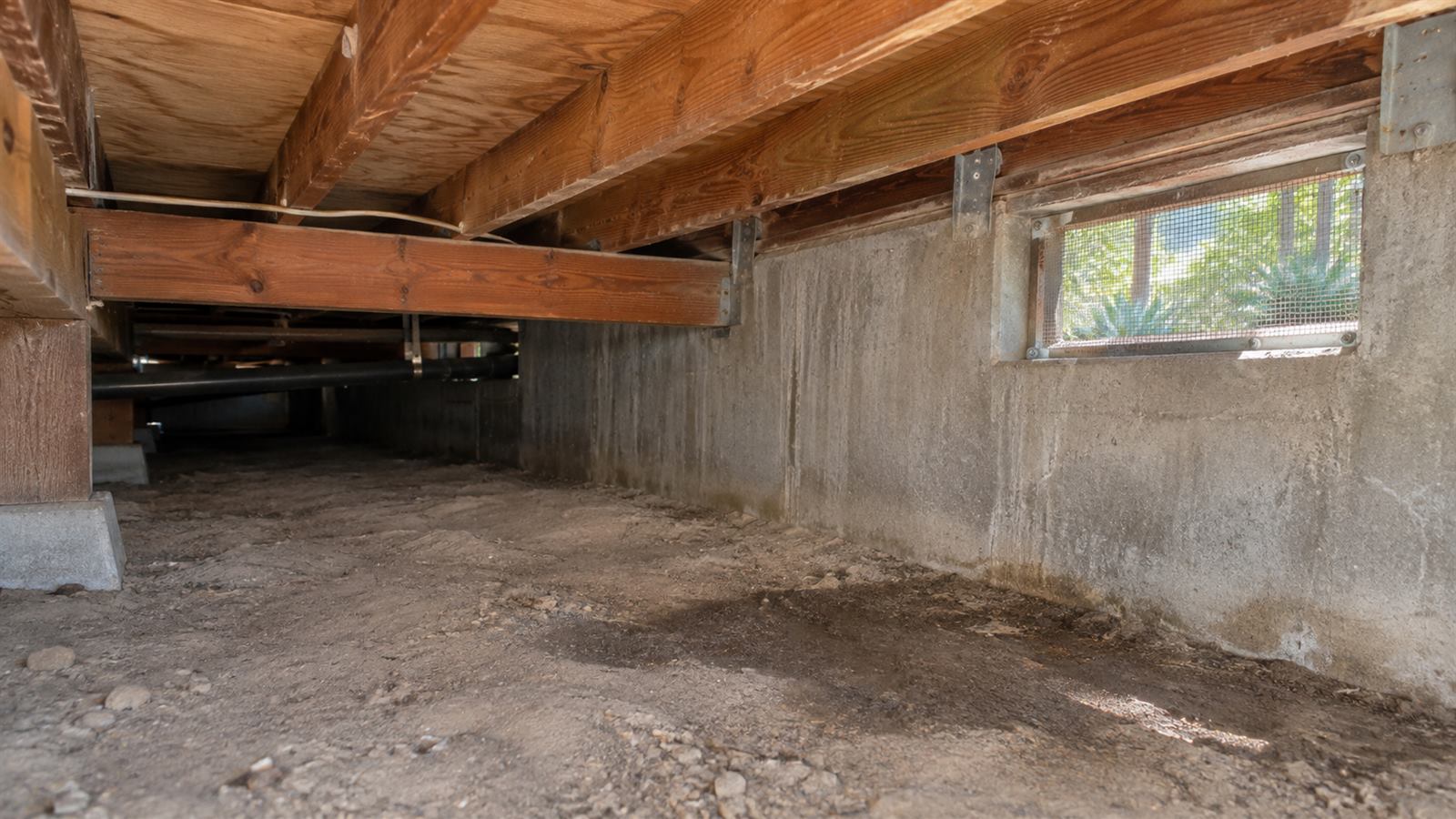
San Diego has almost no basements and two foundation types that fail in completely different ways. Crawl space vs slab is not an academic distinction: knowing which one you have tells you where to look first and saves a lot of wasted investigation.
Quick answer
How do I know if my San Diego home is on a slab or a crawl space? Check the exterior stem wall for foundation vents — screened openings roughly every eight to ten feet near ground level. If they are there, you have a raised floor over a crawl space. Also check whether the floor sounds hollow underfoot and whether there is a step up from the garage slab into the house. As a rough rule, San Diego homes built before about 1950 are raised floor and homes built after about 1955 are slab-on-grade.
How to tell which you have
- Foundation vents. Walk the perimeter. Screened openings in the stem wall near ground level mean a vented crawl space. No vents anywhere means slab.
- Floor sound. A raised wood floor sounds hollow and has a slight give. A slab floor is dead underfoot.
- Step from the garage. A noticeable step up from the garage slab into the house usually indicates a raised floor.
- Access hatch. A crawl space access door in the stem wall outside, or a hatch in a closet floor or hallway.
- Age. Pre-1950 San Diego housing is overwhelmingly raised floor — North Park, Ocean Beach, Golden Hill, Mission Hills, Old Town National City, the La Mesa Village, Old Escondido, South Oceanside. Post-1955 is overwhelmingly slab — Clairemont, Mira Mesa, Tierrasanta, Rancho Bernardo, Eastlake, Santee.
Plenty of homes are both, because an addition was built on a slab against an original raised-floor house. That junction is itself a recurring moisture failure point.
Crawl space homes: what goes wrong
A raised-floor house stays dry through continuous cross-ventilation under the floor. The dominant failure in San Diego is that this ventilation has been lost. Over decades, almost every older lot has gained a patio, a driveway, a side-yard concrete walk, a raised planter bed or an addition — and each one blocks or buries foundation vents.
Once air stops moving, soil moisture evaporates into a closed cavity and condenses on the cool underside of the subfloor. Add an eighty-to-hundred-year-old cast-iron drain line dripping onto the soil, and you have the classic San Diego crawl space job.
Where mold appears: subfloor sheathing, joists, the bottom of wall plates, insulation. How you notice: a musty smell in the lowest rooms and closets, soft or cold floors, cupping hardwood. Typical cost: $2,200 to $6,500.
Slab homes: what goes wrong
A slab house has no cavity under the floor, so there is nothing to ventilate — but it has two different problems.
Pinhole slab leaks. Soft copper in or under the slab corrodes from the outside over fifty to seventy years. San Diego's 1950s to 1980s build-out is squarely in that window. The water spreads laterally along the top of the concrete under the flooring and surfaces at the slab edge, sometimes twenty feet from the break and in a room with no plumbing at all.
Capillary moisture. Pre-1980 slabs frequently have no under-slab vapor retarder. Where the water table is shallow — the San Luis Rey valley in Oceanside, the Mission Valley floor, low-lying Imperial Beach and National City — moisture moves continuously up through the concrete into flooring adhesive, base plates and the bottom edge of drywall.
Where mold appears: at the base of walls, under flooring, behind baseboard, in the bottom of cabinetry. How you notice: swollen baseboard, lifting flooring, a warm floor spot, a water bill step change. Typical cost: $3,500 to $8,500.
The diagnostic difference
This is the practical payoff of knowing which you have.
In a crawl space home, a musty smell with nothing visible means go under the house first. Check vent clear area, the vapor barrier, standing water, the condition of cast-iron drains, and whether ductwork runs through the space. Nine times out of ten the answer is there.
In a slab home, a musty smell or base-of-wall damage with nothing visible means run the water meter test first, then moisture map the whole floor plate. Do not open the wall with the damage until you know where the water came from, because it is usually the far end of the problem rather than the source.
The long-term fix differs too
Crawl space: restore ventilation where the climate allows it, or encapsulate where it does not. Near the coast — Ocean Beach, Coronado, Mission Beach, the Del Mar Beach Colony — restored ventilation often will not work, because for months of the year the outdoor air is more humid than the crawl space air. Encapsulation with a sealed vapor barrier and a dedicated dehumidifier is the reliable answer there. Inland and on the mesas, clearing the vents plus correcting grade and drainage is often sufficient and much cheaper.
Slab: the question is almost always repipe versus spot repair. In a home with original copper from the 1950s to 1970s, the rest of the system is at the same point in its life as the pipe that just failed. An overhead repipe through the attic removes the slab from the equation permanently.
What each failure actually costs to put right
Raised floor over a vented crawl space. The design depends entirely on cross-ventilation, and in San Diego that ventilation has usually been destroyed over seventy or eighty years by patios, planters, raised beds, decks and added hardscape covering the vents. Once airflow stops, ground moisture and marine air sit under the house, the underside of the subfloor stays damp, and the first sign upstairs is a smell that is strongest in the morning and strongest near floor penetrations. Remediation means removing and replacing the vapour barrier, cleaning or removing affected subfloor and joist material, and — the part people skip — restoring the vent clearance or encapsulating properly. Indicative range for the county: $2,200 to $6,500.
Slab-on-grade. The failure is almost always a supply line in or under the slab. Mid-century construction used soft copper run through the pour; after fifty to seventy years, pinholes appear where the copper contacted concrete or rebar. The leak is under your feet, pressurised, and can run for months. The signature is a warm patch on the floor, a water meter that moves with everything off, a step change in the bill, and baseboard damage on an interior wall with no fixture nearby. Indicative range once mold is involved: $3,500 to $8,500, plus the plumbing repair.
Which is actually better to own in this climate
Neither, and that is the honest answer. A raised floor gives you access — a leak can be found, reached and repaired from below, and the subfloor can be dried. Its weakness is that it depends on a ventilation path that the last three owners probably built over.
A slab gives you no cavity under the living space and no crawl-space humidity path, which removes an entire class of problem. Its weakness is that when the problem does come, it is concealed inside concrete, it has usually been running a long time before anyone notices, and the drying time for a saturated slab is two to four weeks rather than days.
What matters more than which you have is whether anyone has looked. A crawl space inspected once every couple of years, with the vents kept clear and a sound vapour barrier, is a low-risk building. A slab with a water meter checked once a year is a low-risk building. Neglected, both fail in the way their construction dictates.
Frequently asked questions
Are San Diego basements a thing at all?
Rarely. A handful exist in older Coronado Village and Bankers Hill homes, in some hillside properties in La Mesa, Point Loma and Del Mar where a lower level is cut into a slope, and in contemporary custom homes with subterranean garages, wine rooms and media rooms. Where they do exist in San Diego they are consistently damp, because below-grade waterproofing was not a local construction tradition and groundwater at low coastal elevations is shallow.
Is one foundation type better than the other for mold?
Neither is better overall; they fail differently. Crawl space homes give you access — you can physically inspect the underside of the floor and the plumbing, which is an enormous diagnostic advantage. Slab homes hide everything under concrete but have no cavity to ventilate and no soil moisture evaporating under the floor. In practice we take about as many calls per home from each type.
My house has both. What does that mean?
It means an addition was built on a slab against an original raised-floor house, which is very common in North Park, Ocean Beach, South Oceanside and Old Escondido. The junction between the two is a recurring moisture failure point: the slab edge sits against the original stem wall, grade is often built up at that line, and the addition frequently blocked foundation vents on that elevation. We inspect that junction specifically on mixed-foundation homes.
Should I encapsulate my crawl space?
Encapsulation works well where the ground is the dominant moisture source and the vents can no longer be restored, but it has to be done completely — sealed liner up the stem walls, sealed seams, vents closed and conditioned air or a dedicated dehumidifier introduced. A half-encapsulated crawl space with blocked vents is worse than a vented one, because it traps moisture with no path out.
How do I check for a slab leak without calling anyone?
Shut every tap, appliance, irrigation valve and ice maker, then watch the water meter's smallest dial for ten minutes. Any movement means water is escaping into the building or the ground. It costs nothing and catches most slab leaks.
Related reading
- crawl space mold removal in San Diego
- slab leak mold damage repair in San Diego
- mold removal North Park
- mold removal Clairemont
Need help with this in San Diego? We provide Crawl Space Mold Removal in San Diego across all 34 service areas. Free phone consultation, 24/7 — (858) 400-3506.