The Marine Layer and Mold in San Diego: What May Gray and June Gloom Do to Your House
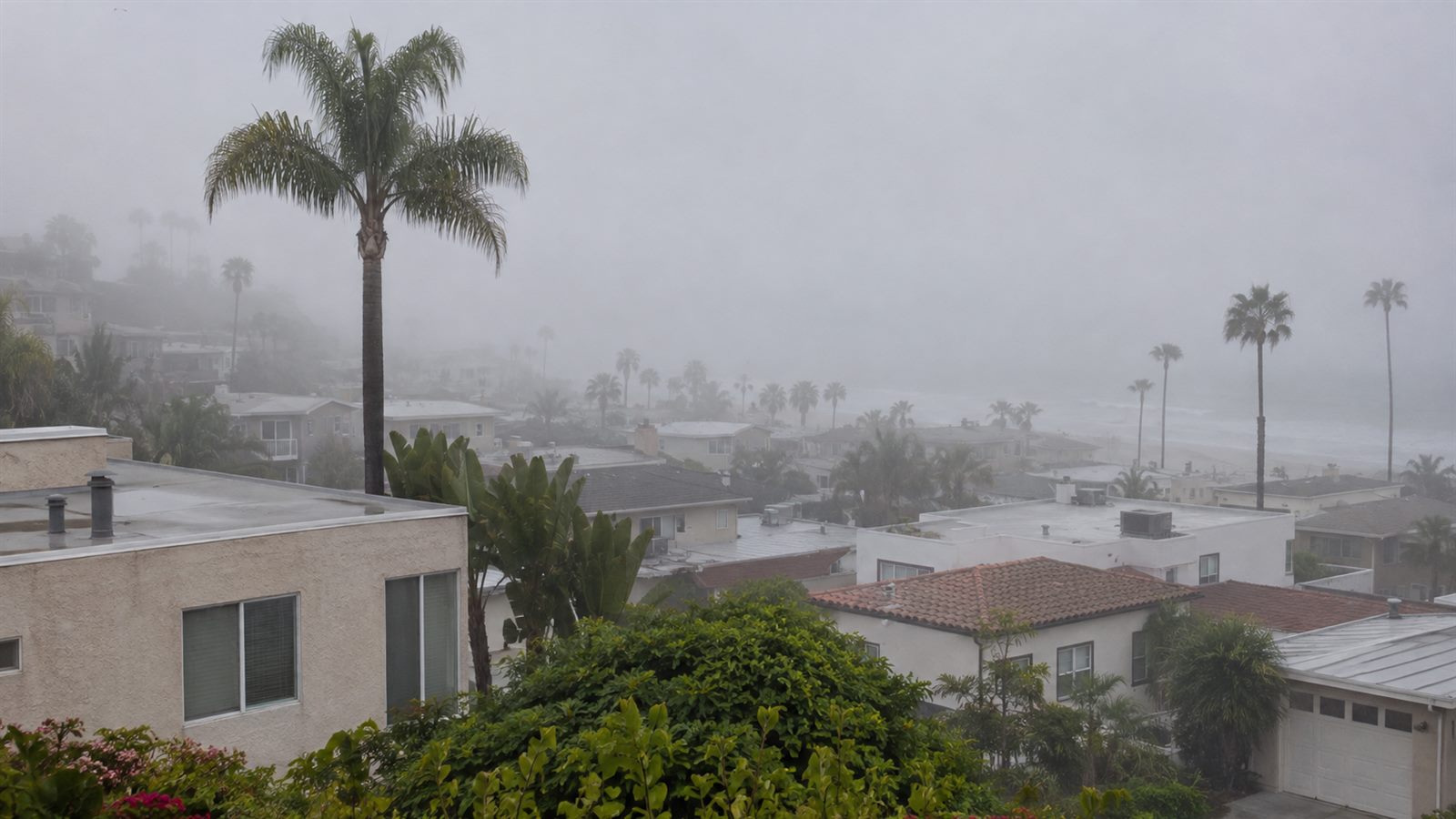
San Diego averages around ten inches of rain a year and still produces an enormous amount of mold. The reason is not rainfall. It is four months of saturated morning air in houses that were built without any way to dry themselves.
Quick answer
Does the marine layer cause mold in San Diego homes? Yes, indirectly and very commonly. The marine layer holds coastal morning relative humidity in the 80 to 90 percent range for much of May through September, and most coastal San Diego homes have no air conditioning or dehumidification, so interior humidity tracks the outdoors. Sustained relative humidity above about 60 percent is enough for mold to grow on cool surfaces — closets, north-facing exterior walls, the backs of furniture — with no leak anywhere.
What the marine layer actually is
Cool ocean water off Southern California chills the air directly above it, creating a shallow layer of cool, moist air trapped beneath warmer air aloft. Onshore flow pushes that layer over the coastline overnight, where it sits until daytime heating burns it off.
In May and June the pattern is at its most persistent, producing the local phenomena known as May Gray and June Gloom, when the overcast can hold until midday or not clear at all right at the shoreline. For a building, what matters is not the grey sky but the number of consecutive hours at high relative humidity.
Why this grows mold without a leak
Mold does not need liquid water. It needs sustained moisture at the surface of a material, and the practical threshold is roughly 60 percent relative humidity at that surface.
Here is the mechanism that catches people out. Ambient room humidity might read 65 percent on a hygrometer, which sounds borderline. But the air immediately against a cool north-facing exterior wall, or inside a closed closet on that wall, is several degrees cooler — and cooler air at the same moisture content has a higher relative humidity. The surface microclimate can sit in the 75 to 85 percent range while the room reads 65.
That is why coastal mold appears first in closets, behind furniture pushed against exterior walls, inside wardrobes, on leather goods and on the backs of pictures. Those are the stagnant, cool spots.
Which parts of San Diego County are worst affected
The exposure gradient runs from the shoreline inland and it is steep.
- Highest: Mission Beach, Imperial Beach, Ocean Beach, Pacific Beach, Coronado, the Del Mar Beach Colony, La Jolla below about 80 feet, oceanfront Oceanside and Carlsbad. Narrow lots, low elevation, little airflow, and in Mission Beach essentially no part of the neighborhood that escapes it.
- High: Point Loma's bay side, Bay Park's lower blocks, lower Cardiff-by-the-Sea near San Elijo Lagoon, the Carlsbad lagoon corridors, the Buena Vista corridor into Vista — places where humid air drains in and pools overnight even well inland.
- Moderate: Clairemont, University City, Hillcrest, North Park, Mission Valley — the mesas clear the marine layer by mid-morning most of the year.
- Low: Tierrasanta, Scripps Ranch, Poway, Rancho Bernardo, El Cajon, Santee, Escondido. These have an entirely different mold profile, driven by plumbing and by evaporative coolers rather than by ambient humidity.
The lagoon effect in Carlsbad and Encinitas is worth highlighting: a home two miles inland but a quarter mile from Agua Hedionda or San Elijo can run higher overnight humidity than a home on an exposed bluff closer to the water.
The mistake almost everyone makes
Opening the windows in the morning.
It is the natural response to a stuffy, damp-feeling house. From May through September at the coast it frequently makes things worse, because the air you let in holds more water than the air it displaces.
The right pattern is counterintuitive: keep the house closed through the humid morning and ventilate in the mid to late afternoon once the marine layer has burned off and the dew point has dropped. A $15 hygrometer indoors and another in the shade outdoors will show you the crossover for your own address within two or three days.
What actually works at the coast
- Measure. Hygrometers in two or three locations, read over a week. Everything else follows from the pattern.
- Make existing ventilation work. Verify every bathroom fan terminates outside the building, not in the attic. Run them twenty minutes after showers with a timer switch. Vent the dryer and the kitchen hood outdoors.
- Dehumidify. In a coastal home without air conditioning this is the single most effective purchase at $200 to $600. Set it to hold 50 to 55 percent, plumb the drain so it never shuts off on a full bucket, clean the filter monthly.
- Move the air at cool surfaces. Closet doors ajar, furniture a few inches off exterior walls, a fan on low.
- Deal with the crawl space. In a raised-floor home it is usually the largest moisture reservoir in the building, and near the coast ventilation alone will not fix it — for months of the year the outside air is wetter than the crawl space air.
The number that decides everything: surface temperature against dew point
Mold does not respond to the humidity reading on your phone. It responds to the water activity at the surface of a material, and that is set by how far a surface sits below the dew point of the air touching it. The marine layer matters because it raises the dew point overnight while leaving surfaces cool.
A worked example from a Pacific Beach wall. Outdoor air at 6 a.m. in June: 63°F, 88% relative humidity, dew point roughly 59°F. An uninsulated west-facing wall that lost heat all night sits at 58 to 60°F. The interior face of that wall is therefore at or below the dew point of the air in the room, and condensation forms — invisibly, in a thin film, every night, for months. No leak, no plumbing, no storm. Behind a wardrobe or a headboard, where air cannot move, the film does not evaporate during the day and the surface stays above 0.80 water activity, which is all most household genera need.
This is why the coastal mold season is May to September rather than the rainy months, and why the usual coastal complaint is a smell and a closet wall rather than a stain.
Why the housing stock makes this coast worse than other coasts
Three construction facts compound the climate. Most coastal San Diego housing was built without mechanical cooling, because the climate never demanded it. No air conditioning means no dehumidification, so indoor humidity tracks outdoor humidity with a lag. Pre-1980 walls on the coast frequently have no cavity insulation, which is what lets the interior face of the wall fall to outdoor overnight temperature in the first place. Chloride-laden fog corrodes galvanized flashing, fasteners and window drip edges on a timescale of decades, so the envelope defects that let storm water in are concentrated in exactly the zone where humidity is already high.
A 1960s Ocean Beach bungalow and a 2015 Carlsbad house in the same marine air behave nothing alike. The newer house has a tight envelope, a vapour retarder and a cooling system, so humidity stays where the thermostat puts it — and its failure mode is different: when water does get in, a tight assembly does not dry on its own.
Frequently asked questions
Why does my house smell musty only in the morning?
Because the marine layer is at its strongest overnight and into the morning, which is when interior surface humidity peaks and when actively growing mold releases the most of the volatile compounds that produce the smell. It is also when the house has been closed longest. A musty morning smell that fades by afternoon is a classic coastal San Diego ambient-humidity signature, and it is worth investigating rather than accepting.
Is the marine layer worse than it used to be?
The year-to-year variability is large and we are not climate scientists, so we will not claim a trend. What we can say from the work is that the housing stock has changed in ways that make it matter more: tighter envelopes from energy retrofits, more sealed-up homes, more converted garages and ADUs with no mechanical ventilation, and more short-term rentals that sit closed between guests.
Do I need air conditioning to control this?
No, and a dehumidifier is usually the better buy. Air conditioning removes moisture as a side effect of cooling, so it only dehumidifies while it is running, and in a mild coastal climate it does not need to run much. A dehumidifier removes moisture directly and runs on humidity rather than temperature, which is exactly the control you want here — at a fraction of the installation cost.
Should I open the windows to air out a damp coastal room?
Only in the afternoon. Opening up at 6 a.m. in June brings in air at 85 to 90% relative humidity and raises the indoor dew point. Mid-afternoon air is the driest of the day, and that is the window worth using.
Related reading
- indoor air quality testing in San Diego
- indoor humidity control in coastal San Diego
- mold removal Mission Beach
- mold removal La Jolla
Need help with this in San Diego? We provide Indoor Air Quality Testing and Improvement in San Diego across all 34 service areas. Free phone consultation, 24/7 — (858) 400-3506.