Swamp Coolers and Mold: The East County Problem Nobody Talks About
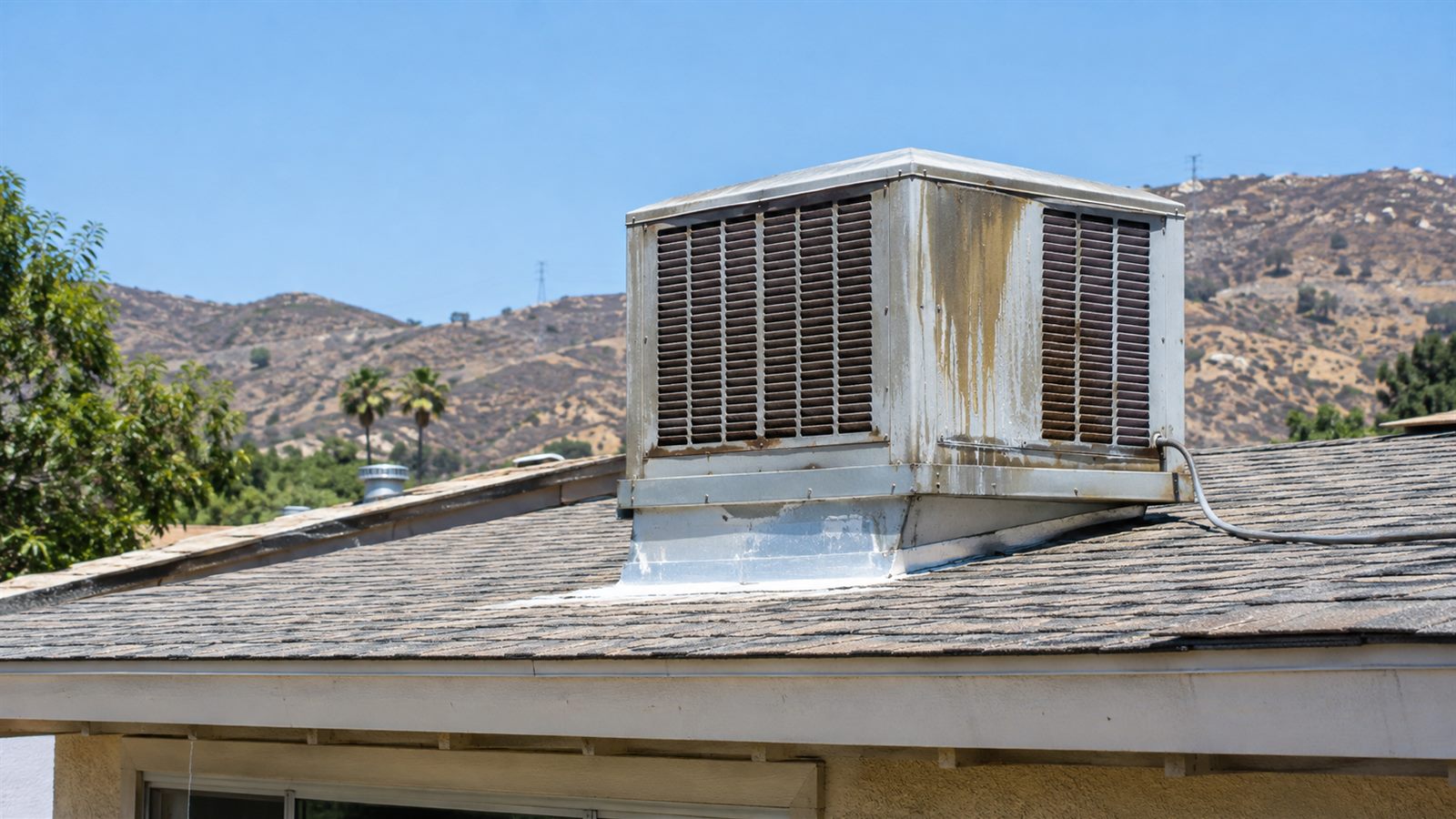
An evaporative cooler cools by putting water into the air you breathe. That is the mechanism, not a side effect. Run it the way most people do and it can push a house twenty points of relative humidity past the point where mold grows.
Quick answer
Can a swamp cooler cause mold? Yes. Swamp cooler mold is one of the most common findings in inland San Diego County, and the cooler itself is the cause: an evaporative cooler cools by evaporating water into indoor air, which can raise relative humidity from the twenties or thirties into the sixties or seventies — past the threshold where mold grows on building materials. The failure is almost always inadequate exhaust: a cooler needs windows or vents open on the far side of the house so the humid air passes through and leaves.
How the mechanism works against you
An evaporative cooler draws hot dry outside air through a wetted pad. The water evaporates, which absorbs heat, and the air arrives in the house cooler and much more humid. In Yuma or Palm Springs that trade is excellent because the starting air is extremely dry.
In El Cajon, Santee, Escondido and Spring Valley it still works — but the moisture has to go somewhere. A cooler is a one-way air supply: it pushes air in continuously. If the house is closed up, that humid air stays and the relative humidity climbs all afternoon.
Then the sun goes down. Inland San Diego swings 25 to 35 degrees between a summer afternoon and the following dawn. That warm, moisture-loaded interior air meets cooling wall and window surfaces and condenses on them. Night after night, through a whole summer.
What cooler-driven mold looks like
The signature is growth with no leak anywhere, in predictable places:
- Inside closets, especially on exterior north-facing walls.
- On the back of furniture pushed against exterior walls.
- On ceilings and walls near the cooler's supply outlet.
- On leather goods, luggage, shoes and fabric in wardrobes.
- On window frames and sills, from overnight condensation.
When we are called to a house in El Cajon or Santee with growth in several rooms and no plumbing fault, the cooling system is the first thing we ask about.
How to run one without growing mold
- Provide real exhaust. Open windows or vents on the opposite side of the house from the cooler, sized so the air actually moves through and out. A cooler running into a closed house is the single mistake behind most of this.
- Do not run it in humid weather. On the handful of muggy days inland San Diego gets, a cooler adds moisture to air that is already loaded and cools very little. That is the day to use a fan instead.
- Measure. A $15 hygrometer in a central room. If indoor relative humidity climbs past 60 percent while the cooler runs, your exhaust path is inadequate.
- Maintain the unit. Pads replaced annually, reservoir cleaned, pump and float checked, bleed-off working. A neglected reservoir grows its own biology and distributes it.
- Shut the water off at end of season and drain the unit and the supply line.
The abandoned cooler problem
Many East County homes have a decommissioned cooler still sitting on the roof or an exterior wall, replaced years ago by air conditioning. It is not inert.
- The water supply line is often still connected and pressurised. We find slow weeps from abandoned cooler lines running into attics and wall cavities, sometimes for years.
- The roof penetration is often poorly capped or not capped at all. A cooler sits over an opening in the roof; removing the unit without properly flashing and sealing that opening leaves a direct path for rain.
- The duct into the house may still be open, letting hot humid attic air into the living space and conditioned air into the attic.
If you have one you no longer use, have it removed, the water line properly terminated and capped back at a valve, and the penetration flashed and sealed. It is a half-day job that prevents an attic remediation.
Cooler, air conditioning, or dehumidifier?
Inland, where summer afternoons are genuinely dry, a well-run evaporative cooler is efficient and perfectly reasonable — provided the exhaust path exists. The problem is operation, not the technology.
Air conditioning removes moisture rather than adding it, which is why homes that switched tend to see the closet mold disappear. If you convert, remove the old cooler properly rather than leaving it in place.
A dehumidifier is the wrong tool inland in summer — the air is already dry. It is the right tool at the coast, where the opposite problem applies. This is one more reason generic mold advice fails in San Diego County: the correct answer in Imperial Beach is the opposite of the correct answer in El Cajon.
The numbers: what a cooler does to your dew point
An evaporative cooler lowers air temperature by evaporating water into the air stream. The cooling is real and the energy cost is a fraction of refrigerated air, which is why so much mid-century El Cajon, Santee, Lakeside and Spring Valley housing still runs one. The water has to go somewhere, and it goes into the air you breathe.
A worked case. Outdoor air in El Cajon on an August afternoon: 100°F, 20% relative humidity, dew point about 52°F. The cooler delivers air at roughly 78°F and 60 to 70% relative humidity — a dew point near 64°F. That is a twelve-degree rise in dew point, continuously, for as long as the unit runs.
With windows open, which is how the system is designed to work, that moisture leaves with the air and nothing accumulates. With the house closed up — which is what people do when it is 100 degrees outside, or at night, or because of noise or dust or security — the moisture has no exit. Indoor relative humidity climbs past 65 or 70%, and when the house drops twenty-five or thirty degrees after sunset, that air meets cooling wall and window surfaces and condenses on them. Night after night, through the summer.
Frequently asked questions
How much humidity does a swamp cooler actually add?
It varies with the outdoor conditions and the unit, but a twenty-point rise in indoor relative humidity is a realistic figure for a cooler running into a house with inadequate exhaust. Going from 30 percent to the high fifties or sixties crosses the line where mold can establish on cool surfaces. The only way to know your own numbers is to measure, and a hygrometer costs less than one service call.
Is mold inside the cooler itself a problem?
It can be. The reservoir, pads and housing stay wet and warm, which supports biological growth, and the unit then blows air across that material into your house. Annual pad replacement, reservoir cleaning and a working bleed-off system address it. If a cooler has sat with standing water through an off-season, clean it thoroughly before the first run.
Does this apply to portable evaporative coolers too?
Yes, and arguably more so, because portable units are typically used in a single closed room with no exhaust path at all. A portable swamp cooler in a closed bedroom overnight is a very efficient way to grow mold in that room's closet. If you use one, crack a window and keep the door open.
Do I have to replace my swamp cooler to stop the mold?
Usually not. The failure is almost always how it is run rather than the unit itself: a closed house gives the moisture no exit. Open two or three windows on the far side of the house, keep sustained indoor humidity under 60%, drain the reservoir seasonally and service the float valve, and most houses stop producing growth.
Why is the mold in my closet rather than the bathroom?
Because the mechanism is condensation, not splash. A north-facing closet wall is the coolest surface in the house and the air inside it does not move, so the moisture the cooler added during the day condenses there when the temperature drops after sunset.
Related reading
- indoor air quality testing in San Diego
- mold removal El Cajon
- mold removal Santee
- does a dehumidifier stop mold
Need help with this in San Diego? We provide Indoor Air Quality Testing and Improvement in San Diego across all 34 service areas. Free phone consultation, 24/7 — (858) 400-3506.